Monday, January 28, 2008

Louisiana Presidential Primaries


I don't write about politics very often, though I do vote almost every time there is an election in my area. I do admit to missing one or two local elections but that is very rare.

As an eighteen year old teenager, like almost everyone in Louisiana back then, I joined the Democratic party and when I voted I usually voted democratic. I did not vote in the 1980 presidential election even though I was twenty at the time. I was in the Navy and at the time of the election I was on board the USS Francis Hammond. The Francis Hammond, FF 1067, was at the time of the election deployed to the Gulf of Oman, which is near the Straits of Hormoz just off the coast of Iran, but I very strongly supported Ronald Reagan. As one serving in the US Armed Forces I had a strong dislike for the feeble leadership of Jimmy Carter. Reagan was the only Republican I would have voted for that then.

Four years later, I was back in South Louisiana and still a moderately loyal member of the Democratic Party. I was married, and my wife was pregnant for our first child. I was working as a labourer, doing odd jobs at a local refinery. I met a guy at the plant that was very active in the Democratic Party and he had been a delegate at an earlier Democratic Presidential convention. He told me that he had a copy of the Democratic Party Platform. I mentioned that I would like to read it and he loaned it to me.

I took the Platform home, read it from cover to cover and returned it to it's owner. The next time I had a day off I went to the parish courthouse and changed political parties. I was disturbed by what I read in the platform.

I was now a Republican and got more involved in the political process. I now voted "mostly" Republican, but I did vote independent on occasion and for Democrats I liked if they were running for local offices.

I was never a "party" guy. I have always been willing to vote for the person I thought best even if they belonged to the "liberal" party, because there were still some good Conservative Democrats.

When the Republicans had control of the Congress and the Presidency they proved to be just as addicted to pork (though it was a different cut off the pig) as the Democrats had been. I got more and more disgusted by them, so when I moved and had to update my voter registration, I decided to register independent. I no longer belong to any political party, and I've been registered this way for nearly four years.

Now to the Primary. I will not be able to vote in the primary because you have to be a member of one of the major parties to participate and I am not. With that said, there is NO ONE one the Democratic side of the ticket that I could, with a good conscience, vote for. On the Republican side, depending on who wins the nomination, I MAY BE able to vote for their candidate next November. IF I do I may have to hold my nose when I do it. I may decide to vote third party, but we are to far from that day to even think about it right now. I did vote third party once before (and no it was not for Ross Perot). It is always an option.

Deo Vindice,

Kenith
What I'm Reading

I don't read very fast, in fact I read at about the pace of a crippled turtle, but I do try to read when ever I have spare time. These days I'm reading a number of things. My latest read was John Nevin's 1840's book, A Mystical Presence: A Vindication of the Reformed or Calvinistic Doctrine of the Holy Eucharist. I found this to be a very telling and exciting book. I found Charles Hodges review on the book and I've printed it out and hope to read it soon.

I'm meandering my way through a new biography about Mormon founder Joseph Smith. The books is Joseph Smith: Rough Stone Rolling by historian Richard Bushman. Bushman is a well respected historian and a Mormon.

I'v also started reading the writings of Pope Gregory the Great. These writings are in the Second Series of the Nicene and Post-Nicene Fathers volume XII. I've read the editor's Prolegomena and I'm now reading Gregory's The Book of Pastoral Rule. When I finish this I plan to continue reading Pope Gregory's letters.

Coram Deo,
Kenith

Tuesday, January 15, 2008


A few days ago I became involved in a discussion about the legality or constitutionality of secession. I have long believed that the secession one or more states from our federal union was and is lawful under the United States Constitution. I wrote about this issue a number of years back that article is here: The Constitution and Secession

The discussion I'm presently involved in is at the history section of Christian Forums.

Before the War Between the States (some folks call it the Civil War) New England, which was the section most hostile to Southern secession, had a long history of secessionist movements. This has been brought up in the discussion and here are some of the points made on that issue:

++++++
John Quincy Adams speaking before the Historical Society of New York in April (I think) 1839:
"With these qualifications we may admit the same right as vested in the people of every state in the Union, with reference to the General Government, which was exercised by the people of the United Colonies with reference to the Supreme head of the British Empire, of which the formed a part; and under these limitations have the people of each State in the Union a right to secede from the Confederated Union itself. Here stands the right! But the indissoluble union between the several States of the Confederated Nation is, after all, not in the right but in the heart. If the day should ever come (may Heaven avert it), when the affections of the people of these States shall be alienated from each other...far better will it be for the people of the dis-United States, to part in friendship from each other, than to be held together by constraint..."

In 1842 we find that John Quincy Adams presented a secession petition in the U.S. Congress for some of his fellow Massachusetts citizens:
Congressional Globe, volume XI, page 977
MONDAY, January 24th.--In the House. Mr. [John Q] Adams presented the petition of sundry citizens of Haverhill, in the State of Massachusetts, praying that Congress will immediately adopt measures favorably to dissolve the union of these States.
First. Because no union can be agreeable and permanent which does not present prospects for reciprocal benefit; second, because a vast proportion of the revenues of one section of the Union is annually drained to sustain the views and course of another section, without any adequate return; third, because, judging from the history of past nations, that union, if persisted in in the present state of things, will certainly overwhelm the whole nation in destruction.


Here are the resolutions of 1844 that were the approved by the Mass. Legislature and signed by the governor:
1. Resolved, That the power to unite an independent foreign State with the United States is not among the powers delegated to the General Government by the Constitution of the United States.
2. Resolved, That the Commonwealth of Massachusetts, faithful to the compact between the people of the United States, according to the plain meaning and intent in which it was understood and acceded to by them, is sincerely anxious for its preservation, but that it is determined, as it doubts not the other states are, to submit to undelegated powers in no body of men on earth; That the project of the annexation of Texas, unless arrested on the threshhold, may tend to drive these states into a dissolution of the union, and will furnish new calumnies against republican governments of exposing the gross contradiction of a people professing to be free, and yet seeking to extend and perpetuate the subjection of their slaves.
3. Resolved, That his Excellency, the Governor, be requested to transmit a copy of the foregoing resolves to each of the Senators and Members of the House of Representatives of this Commonwealth in the Congress of the United States.
4. Resolved, That his Excellency, the Governor, be requested to transmit a copy of the same resolves to the Executive of the United States and of the several States. Approved by the Governor, March 15, 1844

+++++++++
This is a fluid discussion and so in response to the other guy in the discussion, I next turn to the Articles of Confederation. The Articles formed the first version of the United States, but confederated government formed by the Articles weas soon replaced by the U.S. Constitution, which formed a wholly new form of government and created a wholly new version of the United States. The U.S. under the Articles was short lived though it claimed to be a perpetual union. I start by quoting the preamble to the Articles:

++++++
To all to whom these Presents shall come, we the undersigned Delegates of the States affixed to our Names send greeting.
Articles of Confederation and perpetual Union between the States of New Hampshire, Massachusetts bay, Rhode Island and Providence Plantations, Connecticut, New York, New Jersey, Pennsylvania, Delaware, Maryland, Virginia, North Carolina, South Carolina and Georgia.

Notice that the Articles proclaimed a perpetual union, but in less than seven years this perpetual union was dissolved by those same states when nine of the thirteen ratified the new Constitution of the United States.Remember what Article VII of Constitution says? It says, "The Ratification of the Conventions of nine States, shall be sufficient for the Establishment of this Constitution between the States so ratifying the Same." So according to the Constitution when nine states ratified the Constitution they would cease to be part of the "perpetual Union between the States" under the Articles of Confederation and would form a new Union under the Constitution. As I mention in the earlier posts, North Carolina and Rhode Island did not immediately ratify the Constitution and were not part of the Unites States when the New U.S. came into being under the new Constitution. All the other states had seceded from the U.S. under the Articles and formed a new U.S. under the Constitution.
+++++++

Coram Deo,
Kenith

Saturday, January 05, 2008


Life


I love life. It is all that I know. My life began 48 years ago in my mother's womb. The meaning of life is an all together different thing than what is life. All our lives are different and we all see things from different vantage points. Still all are lives are finite and relatively short. To live for 100 years is, for us,a very long life, still this is a relatively short period of time.

What is important in this life? Is it pleasure? Is it adventure? Is it doing great things?

I don't think any of the items mentioned above is (in the big picture) all that important. The great deeds preformed by men will all be forgotten in the long run.
We tend to think the exploits of great military leaders to be acts of greatness. We think of Alexander's conquest of Persia or Julius Caesar's conquest of Gaul to be great acts of greatness, but are they really? I don't think so.

I admit that these are important items in Western history. Alexander's conquest brought Hellenistic culture to much of the world. This laid the foundation, linguistically, for the coming of the Gospel of Jesus Christ. Julius Caesar and the Romans united the Mediterranean world so that Gospel of Christ could quickly spread without having to cross national boundaries.

God used the selfish exploits of ungodly men and military accomplishments of egocentric leaders such as Julius Caesar and Alexander of Macedonia to lay the groundwork for the coming Saviour. We live in a fallen world and big events are mostly the acts of ungodly evil men, but even when men do things for evil, God uses these same acts to accomplish His holy will, which is for good and for the salvation of the world.

The meaning of life for the Alexander or Caesar was all about "ME." Power for ME. Glory for Me, Wealth for ME. Sexual exploits and pleasure for ME. Monuments for to ME. ME is the god of Men like Alexander and women like Cleopatra and their god is a god of death and destruction.
The God of Scripture is the God of life and salvation. In the Bible the writer of Ecclesiastes deals with the meaning and purpose of human life. It is, as a whole, very depressing. In it we find a writer who has sought meaning and purpose in armies and he finds this to be void of purpose. He seeks fulfilment in sexual exploits and is disappointed. He seeks to make life worth living by architectural achievements that would last a millennia and this too left him without meaning. In the end he repents and concludes "Fear God and keep his commandments, for this is the whole duty of man."

The writer of Ecclesiasties found out the truth. All else is vanity and death.

Coram Deo,
Kenith

Friday, December 28, 2007


I love to study history, theology, current affairs on an international level, and most other things as well. This,of course, does not necessarily mean that I know a whole lot about any of those subjects, but I like to think that I have at least a little better handle on things than Joe Sixpack.

Don't take that as a put down on Joe. I don't mean anything derogatory toward my friend Mr. Sixpack. Most Joe Sixpack's that I know are interested in their home, wife, kids the game their favourite teams will be playing in on the next weekend. There is nothing wrong with Joe and there are times when I wish I did not find these other issues so interesting.

I'm a blue collar worker. I am an operator at an oil refinery in South Louisiana and before that I worked as a scaffold carpenter. My work world is the world of Joe Sixpack and I love it. I like working with construction "hands" and other blue collar folk.

Conversations at work are filled with discussions of football (American style), deer hunting, cattle raising, four wheel riding, bass fishing, etc... I like to hunt, though I am not very good at it. I like to fish, which I am even worse at and I am very interested in LSU football. I also have a wife and four children. These items, along with our work, give me many points of contact with my friends at work.

Still, where I work, I am the only one that I know who can name all the Tudor and Stewart monarchs. I am the only one who's read Suetonius' De vita Caesarum (Life of the Caesars) or Jordanes' Lives and Deeds of the Goths. I am also the only one who's read all of Justin Martyr's works, all the letters and several treatises of St. Cyprian, and a fair chunk of other Church Fathers like Polycarp, Ignatius, Athanasius, Augustine, etc

I don't know much about the latest Hollywood starlet, or what is in the gossip columns. I have a very shallow knowledge of pop culture, but my wife has recently confinced me that such knowledge could be useful when I am speaking with young people. So I hope to start learning some of that stuff, but I plan to do so in moderation. I just does not interest me.

What I've basically admitted above is that for my world and the line of work that I'm in, I am a bit of an odd ball. But that is ok. One of my good friends at work was introducing some new hires to everyone and when he got to me, with his East Tennessee accent, and a bit of a chuckle, he said "This is Kenny. He knows more useless bullshit than anyone else in the world."

My friend, we call him Bird, was having a bit of fun and he was giving me a complement (in his own way). Anytime there is a crossword puzzle with some obscure history or geographic question on it they come to me looking for an answer. They always act shocked when it is something that I don't know off the top of my head.

I'm not a complicated person. Though I do admit that somethings may seem gray, it is only because of our lack of light to perceive its true color. When all is revealed in the brilliant light of God at the final day we will see that there was no gray.

My oldest son, who is now serving in the U.S. Navy, once told me that I was the last man on earth who still believed in Christian chivalry. He was not happy with me at that moment and he meant it as a jab, but I took it as a complement. Since that time he has acknowledged that such chivalry is a good thing to have. I only wish the accusation were more true about me than it is.

I'm 47 years old, and unless I live to be a very old man, which is not likely, I have already lived well over half my life. The most heroic thing that I have done in my life is love my wife and children and go to work every day to support and provide for them.

My adult life is not one that would make a good Hollywood movie. I've worked hard and I've worked a lot. I've never cheated on my wife and just as importantly I have never cheated on the mother of my children. I pray with my children when I am home and encourage them to pray. I tell them to remember that they are baptised into Christ and that salvation is not to be found outside of Jesus Christ and His Church.

I sometimes wish I were rich and I did not have to work so hard to provide for my family and to keep what we have, but then I look into my soul and know what demons and misdeeds might be released from my heart if life were too easy. I think great riches and great poverty are damaging to the soul, and I am glad that I've had to work hard for what we have and that I have to continue to work hard to keep it. It is not always fun, but it is much safer for the soul than great riches or extreme poverty.

A Christian culture can not be achieved in the passing of laws or constitutional amendments, though these things can sometimes be helpful, godly culture can only be realised by men and women living their everyday lives in a godly way. There is no magic and there is no silver bullet.

I hope to continue to live that sort of mundane life. I also hope to pass that idea on to my children, and (by God's grace) to my grandchildren. Joe Sixpack is not to far from the truth, but God has to be first, wife and children second, his fellow man, then those other things that he loves.

Coram Deo,
Kenith

Thursday, December 27, 2007

Charles the Great

On Christmas day 800 A.D. Charles the Great, the king of the Franks, and grandson of Charles the Hammer (Charles Martel), was crowned emperor of a vast empire that covered much of Western Europe. Today know this Charles by the name Charlemagne. Charlemagne's empire was made of much of the old western Roman Empire. It stretched from part of Spain to Austria, from northern Italy to the northern parts of Germany.

The empire of Charlemagne was made up of numerous barbarian tribes, their lands and the upon the ashes of the old Western Roman world. It was a vast sea of illiteracy with a few scattered islands of learning. Many of the people in the empire were Christianised barbarians, and this was true of Charlemagne also. But he was a Christian and he did desire to see the Christian faith extended. He encouraged education, literacy and learning; things that the German barbarians had looked down on.

Charlemagne was important for bringing a Christian culture to Post Roman Western Europe. It was a long process. Bibles and other writings were very rare, and those that did exist were hand copied by monks in their cloisters. Theaverage person and even the more prosperous had not change of holding muchless owning or even reading the Bible.
God used the monastic life to preserve his Holy Word through those dark times and we who have the Bible today owe much of what we know to the faithful labours of those monks.

Today, unlike Charlemagne's times, we live in an age and land where the Bible is readily available to anyone who wants one. This is a great blessing that we seldom think about, but for most of church history it was not possible for the average Christian to have access to the Bible.

We need to be diligent to use this great privilege to study God's Word and live our lives accordingly.

Coram Deo,
Kenith

Saturday, December 15, 2007

Saint Polycarp

One of the most renown and beloved saints of the early Church was Polycarp. This great man lived from 69-155 A.D. Polycarp knew the Apostle John and was a disciple of the the beloved Apostle. Irenaues, another great man among the Early Church Fathers, was a disciple of Polycarp. Read what Irenaues wrote Polycarp his teacher. He says "I distinctly remember the incidents of that time better than events of recent occurrence ... I can describe the very place in which the Blessed Polycarp used to sit when he discoursed ... his personal appearance ... and how he would describe his intercourse with John and with the rest who had seen the Lord, and how he would relate their words."

Polycarp became the Bishop of Smyrna and he vigorously defended the Gospel against the growing heresies of his day. He was deeply sorrowed by the rise of heretical movements inside and outside the church, yet he knew that he had to defend the truth against them, and he did for many years.


In 155 A.D. during a festival at Smyrna (these were Olympic like games), eleven Christians were brought into the arena and martyred for the enjoyment of the cheering crowds. The crowd, its appetites whetted with the blood of these saints, called for elderly and beloved bishop Polycarp to be brought in to the arena as well. Men were sent to get him and after a time this was done and he was brought in to satisfy the blood thirsty throng. The political leaders of the town wanted to spare the old man and let him go. They told the eighty-six year old saint that if he would only renounce Christ, he could go free. Here is Polycarp's response to them. "Eighty and six years have I served Him and He hath done me no wrong. How then can I speak evil of my King who saved me?"


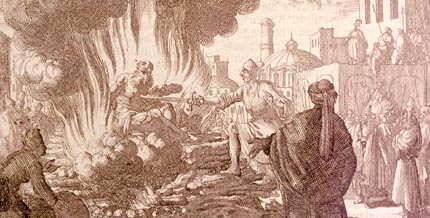
On that same day the second century church's beloved Polycarp joined the growing list of Christian martyrs. He, like so many of his brethren (and our's), he preferred to a suffer cruel death rather than renounce the Lord of Glory. Polycarp was led to a post surrounded by kindling. He knew the Spirit of the Lord would give him the strength to stand firm. A blaze was set and we was burnt at the stake and then stabbed.


We live in trying times, but we, in this country, have not yet been called on to defend the truth of Christ with our lives as have so many Christians of the past have had to do, and as many Christians still have to do around the world even today. In Polycarp's day the Christian Church existed in only small parts of Africa, Asia and Europe and in all these places the faith was outlawed and Christians were, in periodic waves, severely persecuted, tortured and killed. In all the rest of the world then brutal acts of human sacrifice and differing types of cannibalism were quite common. These horrible things were often normal to much of the pagan world. We often forget that the pre-Christian (non-Judaic) world, the pagan world, was a world of pitch-black spiritual darkness.


Today, there are hundreds of millions of Christians and they live in most parts of the world. Our King, Jesus, is, even now, conquering the nations with the power of His Gospel. In Polycarp's day the world was far worse than it is today, because Christianity had not yet tempered any part of it. We are commanded, by our King, to "make disciples of all the nations" and teach them to observe all that He has commanded. There is still much for us to do. There is much that we can learn from Polycarp and other godly men and women who have come before us.


Coram Deo,
Kenith

Sunday, December 09, 2007

Lorenzo dé Medici and Rome

In the late 15th century, Italy was arriving at the pinnacle of the High Renaissance. This is the age and time of Leonardo da Vinci, Michelangelo, and Raphael. It is also the time of political philosopher Nicolo Machiavelli. All of these very talented people mentioned were natives of Florence, Italy. The chief politician of Florence at that time was Lorenzo dé Medici, he was known as the Lorenzo the Magnificent.

Lorenzo, though not holding official government office for most of his rule, was the de facto ruler and near dictator of Florence. Officially, Florence was a Republic, but Lorenzo had inherited his position from his father and his grandfather. He held on to to his power by subterfuge, bribes, ruthlessness, and other political arts.
Renaissance Italy was wrought with political intrigues and violence and Lorenzo flourished in this environment. One of his chief opponents, for a time, and after that one of his chief allies was none other than the Bishop of Rome (i.e. the Pope).

In the late 1470’s Pope Sixtus IV was involved in a plot to overthrow Lorenzo. The plot evolved into an attempt to assassinate Lorenzo and his brother Giuliano, though the Pope insisted that he did not know of the plot to kill the dé Medici brothers. The chief conspirators in the assination plot included several priest and also Francesco Salviati, Archbishop of Pisa. The plot failed, though Lorenzo’s was wounded, and his brother Giuliano was killed. The cleric assassins struck during mass at the cathedral in Florence.

Lorenzo and his followers struck back quickly. They caught and executed Archbishop Salviati and a number of other conspirators that same day. Then Florence went to war against the Pope, who was the earthly prince over the Papal States of central Italy.

After the death of Pope Sixtus IV, Innocent VIII became Pope. The war came to an end, and Lorenzo and Pope Innocent were on good and even friendly terms. As part of the new political alignment, Lorenzo gave his 14-year-old daughter to be wife of the Pope's 38-year-old illegitimate son (Francis).

Lorenzo had much clout with Pope Innocent VIII and he greatly desired a place in the church for his young son, Giovanni. After arranging for his daughter to marry the Pope's illegitimate son. He politicked with Innocent VIII to have young Giovanni made a prince in the church.

In 1488 Giovanni was made a priest, awarded a doctorate in canon law (though he had not yet studied the subject) and also made a Cardinal in the Church. In less than two months the 13-year-old Giovanni dé Medici went from being merely the second son of the tyrant ruler of Florence, to being a Cardinal in the Catholic Church. After these things took place, a good deal of money then passed from Lorenzo dé Medici’s bank to the Papacy.

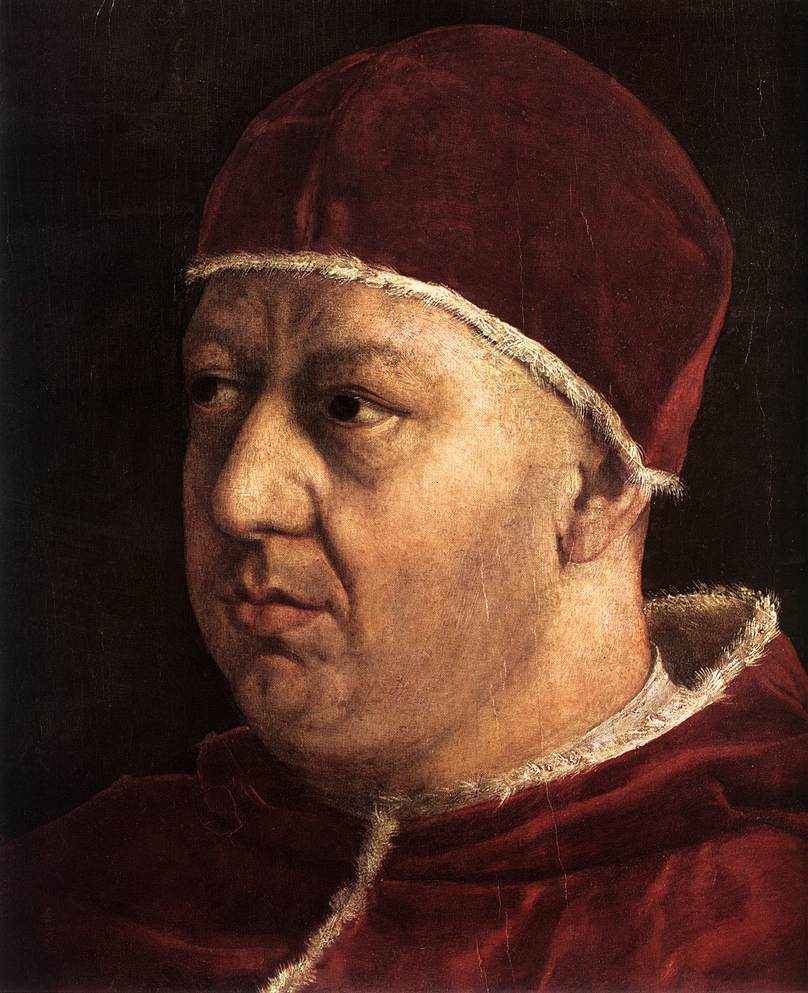
The thirteen year old Cardinal Giovanni dé Medici would eventually become Pope Leo X. It was Leo X who was Pope when Martin Luther nailed his 95 Theses to the castle church door at Wittenberg, Germany which ignited the Protestant Reformation.

The High Renaissance was a time of great papal and church corruption. A glimpse of that corruption can be seen in this thumbnail sketch. Things were, at a number of points, much worse than what is seen here.

There was bound to be a reaction to the theological and political corruption that then existed at the center of the Western Church.

Coram Deo,
Kenith

Saturday, December 01, 2007


J.I. Packer on Theological Liberals

J.I. Packer is on of my favourite living theologians. He is best known for his book Knowing God. The first book by him that I ever read was Evangelism and the Sovereignty of God. That was more than twenty years ago and I still count is as one of my favourite books.

Dr. Packer is a conservative Anglican who is also solidly Reformed.

Recently the 81 year old Packer spoke about the turmoil that is on going in the Anglican Communion, that has been produced by the rise of liberalism in the Anglican Churches in Western World and a large growing, orthodox, evangelical Anglican church in Africa and Asia.

In that talk Dr.Packer said this about theological liberals, "Liberal theology as such knows nothing about a God who uses written language to tell us things, or about the reality of sin in the human system, which makes redemption necessary and new birth urgent. Liberal theology posits, rather, a natural religiosity in man (reverance, that is, for a higher power) and a natural capacity for goodwill towards others, and sees Christianity as a force for cherishing and developing these qualities. They are to be fanned into flame and kept burning in the church, which in each generation must articulate itself by concessive dialogue with the cultural pressures, processes and prejudices that surround it. In other words, the church must ever play catch-up to the culture, taking on board whatever is the “in thing” at the moment; otherwise, so it is thought, Christianity will lose all relevance to life. The intrinsic goodness of each “in thing” is taken for granted. In following this agenda the church will inevitably leave the Bible behind at point after point, but since on this view the Bible is the word of fallible men rather than of the infallible God, leaving it behind is no great loss."

I think Packer's assessment is a good one. He is right on target. When discussing the Christian faith with "liberals" it is of little consequence to them if you can show them that what they hold to is counter to the Word of God, because as a rule they do not believe that the Bible contains the Word of God, except when the Scriptures agree with something that they already hold to.

Theological liberals get their worldview from the culture that they see as evolving and progressing. For them, it would be wrong to tie their believe system to an ancient book that is archaic and at many points vulgar and offensive in it content.

It is interesting that liberals believed that for Christianity to survive it needed to evolve and grow with the culture to survive and remain relevant. What we have seen over the past half century is the steady decline of those Churches that have been most influenced by theological liberalism.

Theological liberalism is anti-Christian and it leads to a slow death for the denomination that is overrun with it.

Coram Deo,
Kenith

Thursday, November 29, 2007


Calvin and the Execution of Michael Servetus


While it goes against popular myth, the truth is John Calvin was not in political control of Geneva (ever) and at the time of Michael Servetus' arrest in that city those in political control of the city men who were opponents of John Calvin. And it was the political antagonists of Calvin who arrested Servetus (though Calvin did turn him in) and was they who conducted the trial of Servetus. These same opponents of Calvin are the ones who sentenced Servetus to death and carried out his execution.

The powers that then controlled Geneva would not allow Calvin to serve weekly Communion in Church, which he desired to do. He could not get his way on the issue of Communion in the Church he pastored because the city leaders vetoed his desires. He could not dictate what happened in worship then, so he certainly did not control what took place on the political level.

When we consider the case of Servetus we have to remember that he had already been captured, tried and sentenced to death by Roman Catholic powers. He had managed to escaped one death sentence when he arrived in Geneva. The city of Vienna, where he had been condemned, demanded his return. The powers in charge of Geneva gave Servetus the choice of returning to Vienna (and certain death) or he could be tried again in Geneva. He chose to stay in Geneva. This is probably because he knew that NO ONE had been executed for heresy in Geneva in all the years that Calvin had been there. This was not true of many places in Europe then.

Calvin did testify against Servetus Like almost everyone else in European culture at that time, Protestant and Catholic alike, he believed Servetus should be put to death. Still, Calvin pleaded with the city to show mercy and have him executed in a human way (They did not heed to Calvin's plea). Those in power checked with the other Protestant cities and the all agreed with the sentence of Servetus. In fact, Calvin was condemned by some of his contemporaries for being too lenient on Servetus.

Calvin stayed by Servetus’ side hoping to convert him to the faith and thereby see him saved spiritually and physically. He pleaded for his conversion, but it was not to be.

Remember that at that time people were being executed all over Europe for heresy (wrong as that may be) but it seems some people, in order to smeer John Calvin's name, only remember a contorted version of this one miscarriage of justice.


Calvin certainly had feet of clay, judged by today's standards there is much about him that we can condemn. But Calvin, like all of us, was a man of his times, and if we are to judge him fairly than we must see him and judge him in the context of his times. When we do that, I believe he shines brightly.


Deo vindice,
Kenith

Wednesday, November 28, 2007

Church Government
The issue of church government is not a burning issue today, and it is not a point of extreme importance to me either, but it is important. I think it is an issue that would be good for us to revisit, with a humble attitude.

Many years ago I did a study to see whether the congregational/democratic form of government, used by the Baptists, or the the federal/rule by elders used by Presbyterians was more biblical. I was thoroughly convinced that the Baptist position was not supported by Scripture, and adopted the Presbyterian system to be the biblical position.


After doing that study I made the move from being a Baptist and adopted the Presbyterian position about church government. It didn't occur to me then that I need to study the issue further and look at the episcopal form of church government as well. The episcopal form (rule by bishops) is the type of government that is used by the Anglican/Episcopal Churches, Roman Catholic Church and Orthodox Churches. I simply assumed that those churches' hierarchical forms had slowly evolved over a long period of time, but I believed that the Presbyterian form was the true biblical of Church government.


The first event that caused me to question my preconceptions on the issue was during a history lecture by Rev. R.J. Rushdoony. Some aspects of the Rev. Rushdoony's work is controversial, but I've found him to be interesting have benefited from reading his books and listening to his lectures. I believe him to be an important scholar.

Many years ago, while listening a series of his lectures on Church history, I heard Rushdoony, a Presbyterian minister, mention that in the earliest days of the post-apostolic church, the church already had (at least) a quasi-episcopal structure.


This raised a red flag for me, but I was not motivated to do an involved study on the subject, though I did now have the matter on my radar screen. Next I learned that a number of Reformed theologians in England maintained an episcopal understanding of Church government.

I have now been reading the Early Church fathers for a number of years, and reading them has confirmed in my own mind was I heard Rushdoony say in his lecture so many years ago. The very early church had some form of hierarchy. I've also started reading on this matter with interest. Earlier this year I read a couple of books defending the episcopal form of church Government. One of them in in particular was very thorough and solidly written. This book was written in 1839 by Archibald Boyd and it is titled, Episcopacy, Ordination, Lay-Eldership, and Liturgies: Considered in five letters. Boyd was a pastor for the Church of Ireland and was arguing for the episcopal position against the Presbyterian form.

I sent part of it to several of my fellow Presbyterians hoping to get input, but I never heard back from them on the matter. I do have more studying to do, but if I had to say at this moment which position I believe to be more biblical, I would have to say that I think some kind of rule by bishops is the more biblical position. I will return to this subject in the future.

Coram Deo,
Kenith

Sunday, November 25, 2007

Beating a Dead Horse

Many times I have written and said that if something is new (theologically speaking) it should raise a red flag in your head. For example, the Dispensational view of the relationship between Israel and the Church did not exist before the early 1800's.

Does that mean that dispensationalism is wrong? No, it does not mean it is wrong. However, I believe it is seriously in error, but that is not necessarily so. Still when you learn of it's newness it should set off a number of red flags and you should study to know how and why it is differs from the historic, orthodox, belief system.

With that in mind, I would like to give you a quote by Rev. John Nevin from his 1846 book The Mystical Presence: A Vindication of the Reformed or Calvinistic Doctrine of the Eucharist. Rev. Nevin writes,

"A strong presumption is furnished against the modern Puritan doctrine, as compared with the Calvinistic or Reformed, in the fact that the first may be said to be of yesterday only in the history of the Church, while the last, so far as the difference in question is concerned, has been the faith of nearly the whole Christian world from the beginning. It included a protest against the errors with which the truth had been overlaid in the church of Rome. It rejected transubstantiation and the sacrafice of the mass; and refused to go with Luther in his dogma of a local presence. But in all this it formed no rupture with the original doctrine of the Church. That which had constituted the central idea of this doctrine from the first, and which appears even under the perversions that have been just named, it still continued to hold with a firm grasp. It is this central idea, the true and proper substance of the ancient faith precisely, that created the difference between the Reformed doctrine and the modern Puritan. In the Reformed system it is present in all its force; in the other it is wanting. The voice of antiquity is all on the side of the Sixteenth Century, in its high view of the sacrament. To the low view which has since come to prevail, it lends no support whatever." (pg 127)

I think Rev. Nevin speaks volumes.

Coram Deo,
Kenith

Thursday, November 22, 2007


Pilgrims, Thanksgiving and BEER

I think I will write something appropriate for Thanksgiving, so here goes.

Why did the Pilgrims land at Plymouth Rock?

If you remember your history (if your American) you know that the Pilgrims were headed for the British colony of Virginia, when a storm blew them for off course to the north. They started back southward when the emergency hit that caused them to abandon their quest for Virginia and to make for the nearest land.

The emergency was they were about to run out of BEER. Yep, those devout Protestant, evangelical, fundamentalist Pilgrims settled at Plymouth because they were running dangerously low in their supply of beer. One of the first things these Pilgrim Fathers did when they made it to shore was brew more BEER!

I believe that BEER is an important part of America's Christian heritage, and we should all have beer or a similar beverage (in moderation of course) when ever we celebrate Thanksgiving. Neither the Pilgrims nor their Puritan cousins were teetotalers.

Another important thing to remember on Thanksgiving is the Pilgrims came here to escape religious persecution and tyranny. The intolerant, oppressive king that the came here to escape was King James I of England. The guy who gave us the King James Bible, which should really be called the "Authorised Version" of the Bible.

King James was a Scot (he's James VI of Scotland). He hated Calvinists and Calvinism, and the Pilgrims were Calvinists, and this is one of the reasons for his persecution of them. King James was also a drunk and a flaming homosexual. The only reason he "authorised" a new translation was so that he could rid Britain of the Geneva Bible, which was loaded with Calvinistic footnotes.

Oh. One more thing. These early Protestant Bibles all contained those extra books that you still find in Catholic Bibles today. Read about it here.

Coram Deo,
Kenith

Sunday, November 18, 2007

TK Joins the Discussion

One of my really close friends wrote to me after reading the discussion between JP and myself. TK asked, "I've got two questions. What is the definition of naked signs and forensic justification? I hate to go to A.R., he makes me look like an idiot. Please make your explanation as simple as possible. This stuff sounded interesting, but I feel like I'm on the sidelines in the intellectual department."

I sent him this reply:
Hey TK,

A naked sign is when the sign is all there is. For example, is the broken bread used in Communion just a sign or symbol of Christ body (no more and no less) to bring it to our memory. If so, than it is a naked sign. The Baptist position is that it is just this sort of sign.

In forensic justification "This doctrine holds that God on His throne declares a sinner "not guilty" for Christ’s sake. Christians, who were once sinners are now righteous because Christ’s righteousness applies to them (i.e., it is imputed to them, or counted as their own)." [sighted from Wikipedia]

Forensic Justification has to do with our legal status before God. He is our judge and we are declared righteous by God in Christ. We can not earn such righteousness it is wholly the Work of God.


I don't think forensic righteousness plays a part in point I was trying to make at all. Those who are ordained to eternal life, from before the beginning of time, will be declared righteous on the last day. A person can believe that and be a Baptist or he can believe that God's covenant and the signs are substantive, even though all in the visible covenant are not also included in the number ordained unto eternal life.

Does that help or even make sense?

+++++++++++++++++++

Happy Thanksgiving,
Kenith

Thursday, November 15, 2007

More Discussion with JP

Here is another Installment of my discussion with JP. I think that this discussion has played itself out. That fact becomes clear when you near the end of this set of emails.

Later,
Kenith

****************************

My confusion is neither with perseverance or preservation nor with the branches
Nor with the question of not being allowed to quit believing. The fact is, if you quit believing and reject his salvation you have no hope no matter how sincere you think you once were.
I am speaking to the use of the words "inserted into Christ" and "partaking in his righteousness." Baptism can be all that you say about the "visible" church, but when it redefines justification and free grace--that is confusing. Is a baptized child more fit to address the judgment seat of God than he was a minute before baptism. Has he been made fit by the mystery? if so how long does it last? What happens when the child grows up to be an Esau or Judas or little devil? What do we say? He never was part of the invisible church. And we can't know that. I understand. But why then should we grant the child justification contingent upon baptism? Especially, if its true faith that lays hold of that righteousness and not baptism. It’s the child’s lack of faith that is to blame not baptism. Baptism may or may not lead to saving faith. Who knows, save god? So why put the stress on baptism by using those words.


+++++++++++++++++++++++++++

Hey JP,

I hope I can answer you at the point that you say you find confusing.

We know that the children of unbelievers are said to be unclean, and the children of believers are said to be holy (i.e. saints) (I Cor. 7). The children of believers are born into the covenant by being descended from covenant members. Baptism is very important and is our formal engrafting into the covenant, but the child of the believer is declared holy even before baptism. God knows these things and I trust Him and his Covenant promises, therefore I am faithful to give my children the covenant signs as I believe the scriptures teach.

Now let’s move onto some of the language used in the Scriptures when the writer is addressing Covenant members. Let's start with Hebrews 3. Here Paul is addressing "holy brethren, partak[ers] of a heavenly calling" but look at what he says to these holy brethren. He says believers are the temple (house) of the Lord "if we hold fast our boldness and the glorying of our hope firm unto the end." If I can be addressed as "holy" and said to be a partaker "of a heavenly calling" how can I then be warned an told these things are mine with an "if" in front of it?

A little later Paul says to these same holy brethren and partakers of a heavenly calling to, "Take heed, brethren, lest haply there shall be in any one of you an evil heart of unbelief, in falling away from the living God." So the question is, can a partaker of a heavenly calling have at the same time "an evil heart of unbelief." We see that these holy brethren are also warned against "falling away from the living God."

How can they fall away from a God that they don't have?
This is Covenant language. They are counted as Holy because of their place in the covenant. If they are in Covenant, then they are counted as being in Christ and being part of the people of God. If they deny the faith then they are said to be "cut off" from Christ and also to be "fallen from grace." Such terms make sense only in terms of Covenant or the Arminians are correct (which they are not as we both know).

We find this kind of language in the Scriptures many times in both the Old and New Covenants. Often time we find all the visible covenant people to be addressed with the language that is ultimately true only for those who will persevere in the faith. This is common speech that is used everyday.

When a general addresses an army and commends the soldiers under his command as brave and courageous, he knows that a handful of the men will prove to be cowards and weak. Still he does not address the troops as "heroes and cowards" when speaking to his men. He gives the noble title to all even though some, in the end, will prove to be unworthy of it.

Paul, and all the Bible writers, wrote without knowledge of God's decree as to who will be saved in the end. He knows that the Church is the body of Christ and he addresses everyone in the Church with terms appropriate to those who are "ordained unto eternal life" and he is perfectly right to do so. He does not say "I am only speaking to those of you in the Church who will not apostatize." When he addresses the visible church using the names and titles that are, in the end, only be applicable to those who are part the spotless bride of Christ in eternity, he is using normal human speech.

These noble titles like elect, chosen, holy, partakers of a heavenly calling, etc. are applied to the visible people of God many times in the Scriptures. It is common practice and there is no reason for it not to be common. We need to see the forest for the trees when we read such things in God's word.

This is why we find that those same people (you and me included) who are given these titles are also given serious warnings against apostasy. The writes of Scripture knew some would not hold fast, so they give the warnings as a proviso to their covenant standing.

Coram Deo,
Kenith

+++++++++++++++++++++++

I think we are all born in sin, deserving hell, without hope, regardless of our bloodline, and entirely dependent upon free grace. And if all babies or any baby is protected, it has nothing to do with the parent's faith and everything to do with the Father's promise to give his Son a people for Himself. I don't think this means we disregard covenant relationships and normal means of God's ways and intentions, but we shouldn't forget the trouble Paul and John and john the Baptist and Jesus all went to in explain to the Jews and Pharisees that it didn’t matter who your parents are--you must believe or you are not protected--even if you are from the tribe of Benjamin. Paul says if anyone can boast about their stock-try looking at my family-but it doesn't matter. John said we were born not of blood. Does this mean they held no value to covenant relationships? No, but they would not confuse justification with whatever mystery takes place during a child’s baptism.

++++++++++++++

I agree with every point that you make in your last letter. The Scriptures are very clear on that issue.

I often remind my own children that they are marked and belong to Christ by virtue of their baptism and I am then very quick to follow that up by telling them that they have to make their salvation sure by repenting of their sins and believing faith in Jesus Christ.

The Scriptures teach the importance of baptism, because God takes His ordained ceremonies seriously, and of course Faith is vital to salvation and there is no salvation outside of faith in Jesus Christ. People seem to have problems when things are just a little bit complex. We too often see that the Scriptures say one item is important, focus in at that one point and forget that the Scriptures say -- yes this is important, but don't forget the other also. It too is important. We see this in the faith/works debates, as well as debates on many other issues, all the time.

The Scriptures put certain stresses on both. We can not stress the one and ignore the other. Too often we see abuses in this area. One person or group will begin to over stress one item and play down the other. Another person or group will see the error, but instead of a balanced correction, they will go to the opposite extreme in reaction to the earlier error.

We need to work at a biblical balance in all matters.

Coram Deo,
Kenith

+++++++++++++++++

I agree but we must use the right words (those permissible in scripture rightly translated and interpreted) even if it is an antinomy.

+++++++++++++++++++++

I agree with what you say.

So are we together on this? What about paedobaptism?

+++++++++++++++++++++

Maybe, as long as you say it right.
Need some Irish whiskey?

+++++++++++++++++++++

Of course I do. Bring some over and we can drink it from my Quaich.

One evening next week we need to get a group together, sit around a fire, converse and pass around the quaich.

Kenith

Tuesday, November 13, 2007

JP and our discussion
My friend JP is Reformed Baptist and he and I have been having a discussion via email. THe conversation was prompted by the post I wrote earlier about the early Reformed creeds and confessions. We have mostly been discussing baptism but that post is the catalyst that got this discussion moving. This is a first installment, because the discussion is on going.
It begins with his reply to my post which he received in an email from me. What follows is a series of back and forth emails.
I hope someone finds them interesting.
Kenith
*********************************************
Kenny,

I don’t believe they are naked signs but to say that by baptism we are inserted into Christ and can lay hold of his righteousness? Baptism? Only for the believers (or elect babies) can this sacrament be food for the soul?

Too much credit goes to the sacrament as cause rather than its place as a privilege.

JP
+++++++++++++++++++++++++++++++++++++
Hey JP,

Thanks for the comment to my email. In my email I simply gave quotes from some confessions on a very narrow spectrum of theology. They do give further detail elsewhere in their writings that explain these things better.

In baptism we are grafted into Christ (in some way). This is true of the unbeliever as well as the believer, otherwise the scriptures talk of being "cut off" and other such warns would make no sense. “Once Saved always saved” does not deal adequately those many passages, nor does the idea of Baptism being legitimate for believers only.

I do believe that baptism does, in some sense, make you a partaker of the benefits of Christ, but unbelief makes the covenant void even though it is a real covenant and you are responsible for "making the salvation pictured and promised to you in baptism" to be of no effect because of unbelief.

As I have said before on other occasions, baptism is a covenant sign and can be compared with both marriage and citizenship. A person can enter into a marriage with no thought of ever keeping the vow made to his wife and before God. Does this make the man not really a husband? Does his lack of sincerity make him less married? Does he not still receive true privileges from the marriage that he does not intend to be faithful in?

The answer to the first two questions is no and the answer to the last one is yes. He is really married and he does receive true privileges that come only in marriage. The covenant relationship and the privileges received because of it are both very real, but they will be squandered and lost because of his lack of covenant faithfulness.

The Reformers and the Early Church Fathers all spoke in way that we find in the confessions. The Apostles to spoke this way also. We are the ones who say, "Paul couldn't have meant that, therefore he must have meant this” etc... We do see statements like "And now why tarriest thou? arise, and be baptized, and wash away thy sins, calling on the name of the Lord." The washing away of sin is often tied to baptism and as Calvin and the other Reformers oft repeated "You can not separate the thing from the thing signified."

In a covenantal sense, all those who are baptised are now counted among the elect and as having their sins washed. In the end, some will prove to be covenant breakers and they will be cut off from the salvation into which they were baptised. They will not persevere in the faith.

Was their heart ever changed?
No.

Did they ever believe?
Some did, in some way, but it was never a belief unto eternal life.

Were they counted as among the elect?
Yes.

Could they fall away?
Yes, in baptism they were brought into God's covenant, which is the place of salvation and there is no salvation outside the covenant so they are counted as a member of the house hold of faith. But, if they do not take the many warnings in the Scriptures about being “cut off” seriously, and if they did not make their salvation that they have in baptism (covenantally speaking) sure, then they loose the very real benefits of their baptism by their lack of faith.

The same covenant relationship applies to our children, who are joined to household of faith when they are born into Christian homes. By their baptism they are made partakers of the Covenant promises of God and they too are members of Christ, but they too must make the salvation that is theirs by baptism effectual by a living and holy faith in Jesus Christ. To not do so is to betray one's baptism and to betray the Lord Jesus Christ for denying the salvation that was theirs covenatally by way of the generational promises of God.

I hope that makes sense. I will reread it later to check.

Coram Deo,
Kenith
++++++++++++++++++++++++++++++++++++++++++++++
By the way, I do believe we must take seriously the warnings that we are not allowed to quit believing.

However disturbing, it is scripture! This is how must live and we will understand it better in heaven. But claiming righteousness of Christ as something we ourselves have to lose is a catholic teaching of grace. Impartation vs. imputation. Luther did not invent forensic justification.

Am I still completely missing the boat on baptism?

JP
++++++++++++++++++++++++++++++++++++++++++

No. Not completely :-)

The Reformers were not rationalists and they still allowed that there was mystery the grace that was bestowed in the Sacraments (by faith). The Catholics make the grace to be present in the physical aspects of the sacraments and most modern Protestants have gone to the other extreme and deny that the sacraments are a means of grace at all.

The Reformers and early Protestants do not fit into either camp. They remained on the road and did not veer off into either of those ditches.

Coram Deo,
Kenith

++++++++++++++++++++++++++++++++++++++++++++++

We cannot attribute saving grace to those who merely eat or drink or get wet. These sacraments only benefit in a mysterious way those who are under the protection of shed blood. It is one thing to do as we are told—such as in keeping with the covenant, baptize your children; and it is another thing to do it thinking God is obligated now to extend saving grace to my child. He didn’t make that promise. So why put this stress on the sacrament?

JP

+++++++++++++++++++++++++++++++++++++++++++++++
I'm reading a book on the Early Reformed view on the sacraments compared to Reformed views of the sacraments that developed later. The book was written in the 1840's by a guy named John Nevins. His book shows the differences that had already developed at that time (1840’s) between the original position of men like Calvin, Beza, Bucer, etc...

I think Calvin and company had thought these things through pretty well, and I think they have much to teach us on the Sacraments. They strongly disagreed with the Roman Catholics and they just as strongly disagreed with the modern view that makes it no more than a memorial.

Beza and Farel wrote, "The symbols are by no means naked; but so far as God is concerned, who makes the promise and offer, they always have the thing itself truly and certainly joined with them, whether proposed to believers or unbelievers.”

Baptism places the receiver of the sacrament into a covenant relationship with Christ. They enter into the visible Church of God, which is the only Church that we can know. The baptised person is responsible for his baptism. He is responsible to make his salvation sure by true faith in Jesus Christ. If he does not have faith then he will be held accountable for denying the covenant into which he has been baptised. By so doing, he proves himself to be an apostate and to be one who has rejected so great a salvation that should be his because of his covenant status of being “in Christ” (who's body is the church) by virtue of baptism.

The Supper is similar. In it Christ offers himself (His body and blood) to us as nourishment to our souls and we truly partake of him by faith. There is no magic. The bread remains bread and the wine remains wine, but there is mystery. The Sacrament is a means of grace and we are truly offered Christ and partake of Christ by faith. The unbeliever, though offered Christ, does not receive Christ because of the lack of faith, though his presumption and participation in the Sacrament will bring greater condemnation.

It became clear to me while reading the Fathers that all the Church, before modern times, believed that Christ was truly present in the Supper in some "mystical" way and the believer did partake of Christ when he partook of the Supper. I believe attempts to define "HOW" this was so has lead to great error. We should leave it alone and go no further than to confirm that in the Supper we do partake of Christ if we have genuine faith.

I hope that all makes some sense,
Kenith

+++++++++++++++++++++++++++++++++++++++++++++++++++

This I think is true. The supper is offered but no benefit to the unbeliever other than nutritional. No saving or sustaining grace. Same for the water, just gets an unbeliever clean of dirt, other than that nothing is different. The visible church matters in terms of our church order, discipline, etc., but in terms of what makes a child fit to stand before a holy God is of no help. Only by grace thru faith in Christ alone. We baptize our children not because they can as a result claim the righteousness of Christ. That can't be. It maybe an obligation on our part to baptize but…

JP

++++++++++++++++++++++++++++++++++++++++++

I agree.

The Grace that is found in the Sacraments accrue only to those who ordained unto eternal life. Those who receive the sacrament, but do not have faith, receive it at their peril, because these are covenant acts, and God takes "covenant" very seriously. This is why the Covenant people (Jews) who heard Jesus and rejected him will be judged more severely than the people of Sodom and Gomorra. The folks in Sodom may have been (outwardly) more morally corrupt, but they were not covenant people and will not receive the judgment that will befall God's covenant people. This is even more important today, because we have an even better covenant than the people under the Old Covenant.

Coram Deo,
Kenith
++++++++++++++++++++++++++++++++++++++++

I don’t think anyone can explain what is the difference in the eyes of God between a child baptized and a child not baptized. Does the baptism make it easier for God to save him? Does God think one is in a better condition?
It is one thing to say we baptize because we are commanded. And another to say because it helps to get him saved. And even something else to say we baptize because it does in fact dress them in X's righteousness. Which is it? I agree its not empty for the elect, which begs the question as to why we are so careful about who takes communion.

JP
+++++++++++++++++++++++++++++++++
We live in a day when ceremony and covenant are seen by men to be near meaningless institutions. They are not seen as binding and while they may be quant, they are little more than irrelevant. This is true of modern man, but it is not true of the Scriptural teachings where covenant and ceremony are held to have great substance.

Why is sex 30 minutes before marriage sin, but when preformed after the ceremony it is then seen as holy and sanctified before God and man? It is the same act. The feelings of those involved are the same. So what is the difference?

The difference is God has said you must have a covenant stamp on your relationship for it to be holy and not sinful. The act does not change and neither does the feelings, but in the sight of God there is a very radical shift in the relationship between the man and women.

Why?
Because God has said so.

Do we see a difference outwardly?
No, not necessarily, but God's Word says that there is a radical change in that relationship. This is true whether or not the person who goes through the ceremony is sincere or not.

Covenant ceremony may mean nothing to us, but God's ways are not our ways, and He says that they have very serious relationship consequences for His people and those who are not His people.

The same is true of baptism. There is a radical difference between the baptised person and the unbaptised person in the matter of covenant. The one is in a formal covenant with God and the other is not in a formal covenant with God.

This may not mean much to us, but when we look at the texts of Scripture and read what is said of baptism (especially in light of its relationship to circumcision) than it is clearly important in the sight of God.

Can someone be saved outside of Baptism? Yes, but this is outside the ordinary, just as it was in the Old Covenant. Ordinarily those saved are also in covenant (formally) with the Lord.

Can some one be unsaved in the Covenant? Certainly, it happens every day, but that does not mean we can ignore or play down God's established covenant signs and seals and they have consequences for those in covenant. They are a means of grace to those who believe and they are a witness against and bring increased judgment on those that reject their covenant relationship and trample under foot so great a salvation as belongs to them because of their Covenant status.

Coram Deo,
Kenith
+++++++++++++++++++++++++++++++++++++++++++++++++

If God says we must baptize our children then we should take him seriously; regardless of how confusing. It is a sacrament. Of all things about worship this is one thing we should do just as we are told. I agree there is mystery and presence and more than empty signs. All the more reason to be more exact in what we say, so not to walk off a cliff into heresy. That is what concerns me about the silence of scripture in the area of baptizing children. I am inclined to believe it, but is it possible to one minute be clothed in Christ and the next be undressed by your own doing? Is it possible Christ shed blood to save you, and yet, you were beyond his reach? No. No. So how can anyone say baptism “mysteriously" clothes my child and later when he reaches an age of accountability is able to get outside of the reach of the blood and righteousness of Christ? This does not erase the threat in scripture that we are not allowed to quit believing. This does mean that baptism should not redefine even mysteriously so clear a teaching of forensic justification. This seems to change the gospel.

JP
++++++++++++++++++++++++++++++++++++++++++

I don't believe that Calvin or his fellow Reformers would disagree with what you say in terms of forensic justification. All of these men believed firmly as you do there. All believed in the predestination and the sovereignty of God in our salvation just as the Bible teaches. Still the Language of the Scriptures is not the language of systematic theology.

Systematic theology is a fine tool that is a great help to us in our attempt to understand the Scriptures and I enjoy studying it, but it too can distort things. We make divisions in systematic theology that are correct and useful, but these same ideas may not be so clearly divided in the Scriptures themselves.

We see this in some parts of Scripture where works and salvation are discussed. Some folks stress the texts where works and salvation are clearly divided and others stress those verses where they are linked. So which is it?

I think our systematic theology (as does Paul) does a good job explaining how salvation is by Grace and not of works. Still I think some Protestants have taken this and run with it beyond the boundaries that are safe (toward antinomianism), because they over stress grace over works that the Scriptures go out of their way to avoid.

The Catholics and Arminians stress the texts that tie works and salvation together and mostly ignore the ones that clearly differentiate between them. We should take both sets of texts seriously. I think Calvin and the early Reformers were far better at doing this than the Catholics or modern Reformed Evangelicals. Calvin never confused perseverance with its distortion "once saved always saved" as has so many of his modern disciples.

The same is true of his handling of the sacraments. He does a great job dealing with them. And in doing so he avoids the ditches that we too need to avoid.

Later,
Kenith
++++++++++++++++++++++++++++++++++
How do you say a baptized child is clothed with the righteousness of Christ and could one judgement day be rejected on account of his sin--without damaging the doctrine of forensic justification? Is it just these doctrines appear to be at odds but really aren't (such as sovereignty & responsibility)?

JP
+++++++++++++++++++++++++++++++++++++++++++++
JP,

A baptised child is in covenant with Christ. He is a member of the body of Christ. He is part of the "visible" elect people of God. Is he elect unto eternal salvation? I don't know. God's eternal decree as to who is elect unto eternal life is known only to himself, yet He uses covenant language terms like elect, chosen, and called when addressing his Covenant people (visible church) which we know is made up of believers and unbelievers.

Let's look at some instances.
I am the true vine, and my Father is the husbandman. Every branch in me that beareth not fruit he taketh away: and every branch that beareth fruit, he purgeth it, that it may bring forth more fruit. Now ye are clean through the word which I have spoken unto you. Abide in me, and I in you. As the branch cannot bear fruit of itself, except it abide in the vine; no more can ye, except ye abide in me. I am the vine, ye are the branches: He that abideth in me, and I in him, the same bringeth forth much fruit: for without me ye can do nothing. If a man abide not in me, he is cast forth as a branch, and is withered; and men gather them, and cast them into the fire, and they are burned.

Notice that Christ is the vine and His people are the branches. A branch, by definition is attached to the vine, which is Christ. Yet we hear that branches can be "he is cast forth as a branch, and is withered" (i.e. cut off) and even "cast them into the fire, and they are burned."

Can someone abide in Christ and still be "cast forth" and "burned" in the fire? It certainly appears to be so according to Christ words in John 15. I take this warning very seriously I don't think Christ is just giving us a hypothetical possibility.

We both believe those promises that Christ gives that are also recorded by St. John 6:37. Here Jesus said, "And this is the Father’s will which hath sent me, that of all which he hath given me I should lose nothing, but should raise it up again at the last day."

Is there a contradiction between Christ words in John 6 and His words in John 15? I don't think so. Some folks concentrate on one verse and those similar to it that we have found in Scripture and others focus on the other verses that are akin to it. But the problem both sets of texts and found in the Scriptures. Our theology must be able to deal with both in such away that they make sense and fit the context.

I believe both these texts and others like them make perfect sense when we view them from a covnenantal perspective. All in covenant are branches. Are all in Christ predestined to eternal life and given to Him by the Father? No, some branches are not and they shall be cut off and cast forth and thrown into the fire.

All those outside the Covenant exist outside of the salvation that is offered in the covenant. Many will come into the covenant and receive eternal life, others will come in and only to be cut off again for unbelief. Let's look at what Paul says in his letter to "the saints and faithful brethren in Christ which are at Colosse." He writes, "And you, that were sometime alienated and enemies in your mind by wicked works, yet now hath he reconciled In the body of his flesh through death, to present you holy and unblameable and unreproveable in his sight: If ye continue in the faith grounded and settled, and be not moved away from the hope of the gospel, which ye have heard, and which was preached to every creature which is under heaven; whereof I Paul am made a minister..."

What do we make of Paul's "If" in the verses above? Should we take it seriously? I certainly believe we should and I am a Solid Calvinist and believer in the absolute predestination of God in all things. Here is what Calvin says in his commentary, "Here we have an exhortation to perseverance, by which he admonishes them that all the grace that had been conferred upon them hitherto would be vain, unless they persevered in the purity of the gospel. And thus he intimates, that they are still only making progress, and have not yet reached the goal. For the stability of their faith was at that time exposed to danger through the stratagems of the false apostles."

I hope the above note answers your question. I look forward to your next email.

Kenith

Tuesday, November 06, 2007


In January 1534 the Reformed Church of Basel, Switzerland published a Confession of Faith. John Calvin’s theological mentor, Martin Bucer had requested that they publish such a confession to inform the Christian World that they were not “having the Supper without Christ.”

Here is a section of their confession as it pertains to the Supper: “In the Lord’s Supper, (in which with the bread and wine of the Lord are represented and offered to us by the minister of the church the true body and blood of Christ) bread and wine remain unchanged. We firmly believe, however, that Christ himself is food of believing souls unto eternal life; and that our souls, by true faith upon Christ crucified, are made to eat and drink the flesh and blood of Christ; so that we, members of his body as of our only head, live in him as he also lives in us…”

In 1557 at the Colloquy of Worms leaders of the French speaking Reformed Churches gathered. The delegates meeting included such noteworthy Reformed theologians as William Farel, and Theodore Beza (then at Luausanne); there were also representatives from Paris, Geneva, etc…. This esteemed group also produced a confession. Let’s look at this confession's section on the Eucharist. Here we read, “We confirm that in the Supper of the Lord not only the benefits of Christ, but the very substance itself of the Son of Man; that is, the same true flesh which the Word assumed into perpetual personal union, in which he was born and suffered, rose again and ascended to heaven, and that true blood which he shed for us; are not only signified, or set forth symbolically, typically or in figure, like the memory of something absent, but are truly and really represented, exhibited and offered to us…”

They continue, “As it regards the mode now in which the thing itself, that is, the true body and true blood the Lord, is connected with the symbols…We call a sacramental mode not such as is figurative merely, but such as is truly and certainly represented under the form of visible things, what God along with the symbols exhibits and offers, namely, what we mentioned before, the true body and blood of Christ; which may show that we retain and defend the presence of the very body and blood of Christ in the Supper…”

In 1559 the French Reformed Churches their Gallic Confession. On the subject at hand they write, “For although he is now in heaven, and will remain there also till he shall come again to judge the world; we believe, notwithstanding, that through the secret and incomprehensible energy of the Spirit, apprehended by faith. He nourishes and vivifies us by the substance of his body and blood… because this mystery of our coalition with Christ is so sublime, that it transcends all our senses, and so also the whole course of nature.” And then they add, “We believe, as before said, that in the Supper, as in Baptism, God in fact, that is, truly and efficaciously, grants unto us all that is there sacramentally represented; and so we join with the signs the true possession and fruition of what is thus offered to us. We affirm, therefore, that those who bring to the Lord’s Table of a pure faith, truly receive what the signs there testify; namely that the body and blood of Jesus Christ are not less meat and drink of the soul, than the bread and wine are food of the body.”

Now let’s turn to John Knox and the Scottish Church. In 1560, under Knox’s oversight, the Reformed Church in Scotland also produced a Confession. Here is a segment from Knox and company, “We do then condemn the vanity of those who affirm that the sacraments are nothing else but mere naked signs [i.e. the view of Baptists and many (most?) Reformed/Presbyterians today]. Rather we surely believe that by baptism we are inserted into Christ, and made partakers of his righteousness, by which all our sins are covered and remitted. And also, that in the Lord’s Supper, rightly used, Christ is so united to us as to be the very nutriment and food of our souls.”


What follows is a strong denunciation of transubstantiation, and then they continue,
“…in the right use of the sacrament, is effected by the operation of the Holy Ghost… who causes us to feed upon the body and blood of Jesus Christ, once broken for us and poured out, but now in heaven, appearing for us in the presence of the Father… We do notwithstanding firmly believe that the bread which we break is the communion of his body, and the cup that which we bless the communion of his blood; and so we confess that believers in the right use of the Lord’s Supper thus eat his body and drink the blood of Jesus Christ, and we believe surely that he dwells in them and they in him…
”

There is a good deal more that I can add, but this will have to do for this segment. I believe most of my Reformed and Evangelical brethren will be disturbed by the content of the Early Reformed Confessions. I doubt that very many Presbyteries in the PCA would ordain someone who, when he is being examined, repeated the early Reformed statements as his own.

Many, if not most Reformed Christians today, would fit into the group that Knox and his fellow Presbyterians accuse of believing that the sacraments are no more than “naked signs.” Remember what they said of such a position? They wrote, “We do then condemn the vanity of those who affirm that the sacraments are nothing else but mere naked signs.”

The Reformed Churches today need to revisit these issues and see why they are so at odds with the early Reformers like Calvin, Farel, Beza, and Knox on the subject of the Sacraments.

Coram Deo,
Kenith

Thursday, November 01, 2007

1557: What about St. Bartholomew's Day?


I will not make a habit of responding to comments on an earlier blog with a new blog but I feel obligated to do so here. Timothy, in his comment below insinuated that Catholic persecution of Protestants was more myth than reality. I wish he were correct but he is not.

I don't want to get into "Catholic Bashing," because I am not anti-Catholic. I was baptised in the Catholic Church, I have counseled Catholics attending Evangelical Churches not to submit to re-baptism and I even attend Catholic Mass this very morning.

I worked last Sunday and I will so again this Sunday, therefore I will not be able to attend Bethel (PCA). At such times I attend worship services during the week. Sometimes it is at a local Episcopal Church (where I can celebrate the Eucharist) and other times it is at the Catholic Church near my home. I'm sure I attend Mass more than many of my Catholic friends.

I discussed Henry VIII and his appointed Protestant persecutor and executioner, St. Thomas More, in my comment to Timothy below. Now let's move from England to France.

In 1572 French Catholics, massacred tens of thousands of French Protestants (the Huguenots). The slaughter was the brainchild of the queen mother Catherine de' Medici and was agreed to by here son King Charles IX. The blood lust began in Paris, and the first ones killed were of the Protestant nobility, who were in the city to celebrate the marriage of a Catholic princess to a Protestant prince.

The leadership of French Protestants was decimated and never recovered from the blow. Tens of thousands of French Protestants were murdered for their faith and thousands upon thousands more fled France to save their lives. The French Huguenot refuges settled in the English colonies here in America and around the world. They also fled to other Protestant held parts of Europe and maintained great resentment toward the Catholics who slaughtered their French coreligionist.

Modern Popes would be appalled by the slaughter of so much innocent blood, but not Pope Gregory XIII. To his credit, the Pope did not know of the massacre beforehand, but he did have a Te Deum (a hymn of joy and thanksgiving) sung to celebrate the event. He also commissioned a number of paintings and had a coin struck to commemorate the event.

I can touch on many events in many other parts of Europe at that time, but there is no need to continue (at this time) with this subject. The Catholics had the biggest sticks then and the Popes encouraged Catholic rulers to use those sticks on the Protestants when ever they could. We should not forget that Protestants were able to do thier on share of persecuting too.

It is all shameful, but attempts to deny these horrors, or even to discount them, like like I think Timothy did below, will only harm the important need we have for love and reconciliation in the Church of Jesus Christ. We all have dirty laundry and in this case some of it is visible for everyone to see. Throwing a basket over it and saying that it is not there will not fix the problem.

Coram Deo,
Kenith