 Lorenzo dé Medici and Rome
In the late 15th century, Italy was arriving at the pinnacle of the High Renaissance. This is the age and time of Leonardo da Vinci, Michelangelo, and Raphael. It is also the time of political philosopher Nicolo Machiavelli. All of these very talented people mentioned were natives of Florence, Italy. The chief politician of Florence at that time was Lorenzo dé Medici, he was known as the Lorenzo the Magnificent.
Lorenzo, though not holding official government office for most of his rule, was the de facto ruler and near dictator of Florence. Officially, Florence was a Republic, but Lorenzo had inherited his position from his father and his grandfather. He held on to to his power by subterfuge, bribes, ruthlessness, and other political arts.
Renaissance Italy was wrought with political intrigues and violence and Lorenzo flourished in this environment. One of his chief opponents, for a time, and after that one of his chief allies was none other than the Bishop of Rome (i.e. the Pope).
In the late 1470’s Pope Sixtus IV was involved in a plot to overthrow Lorenzo. The plot evolved into an attempt to assassinate Lorenzo and his brother Giuliano, though the Pope insisted that he did not know of the plot to kill the dé Medici brothers. The chief conspirators in the assination plot included several priest and also Francesco Salviati, Archbishop of Pisa. The plot failed, though Lorenzo’s was wounded, and his brother Giuliano was killed. The cleric assassins struck during mass at the cathedral in Florence.
Lorenzo and his followers struck back quickly. They caught and executed Archbishop Salviati and a number of other conspirators that same day. Then Florence went to war against the Pope, who was the earthly prince over the Papal States of central Italy.
After the death of Pope Sixtus IV, Innocent VIII became Pope. The war came to an end, and Lorenzo and Pope Innocent were on good and even friendly terms. As part of the new political alignment, Lorenzo gave his 14-year-old daughter to be wife of the Pope's 38-year-old illegitimate son (Francis).
Lorenzo had much clout with Pope Innocent VIII and he greatly desired a place in the church for his young son, Giovanni. After arranging for his daughter to marry the Pope's illegitimate son. He politicked with Innocent VIII to have young Giovanni made a prince in the church.
In 1488 Giovanni was made a priest, awarded a doctorate in canon law (though he had not yet studied the subject) and also made a Cardinal in the Church. In less than two months the 13-
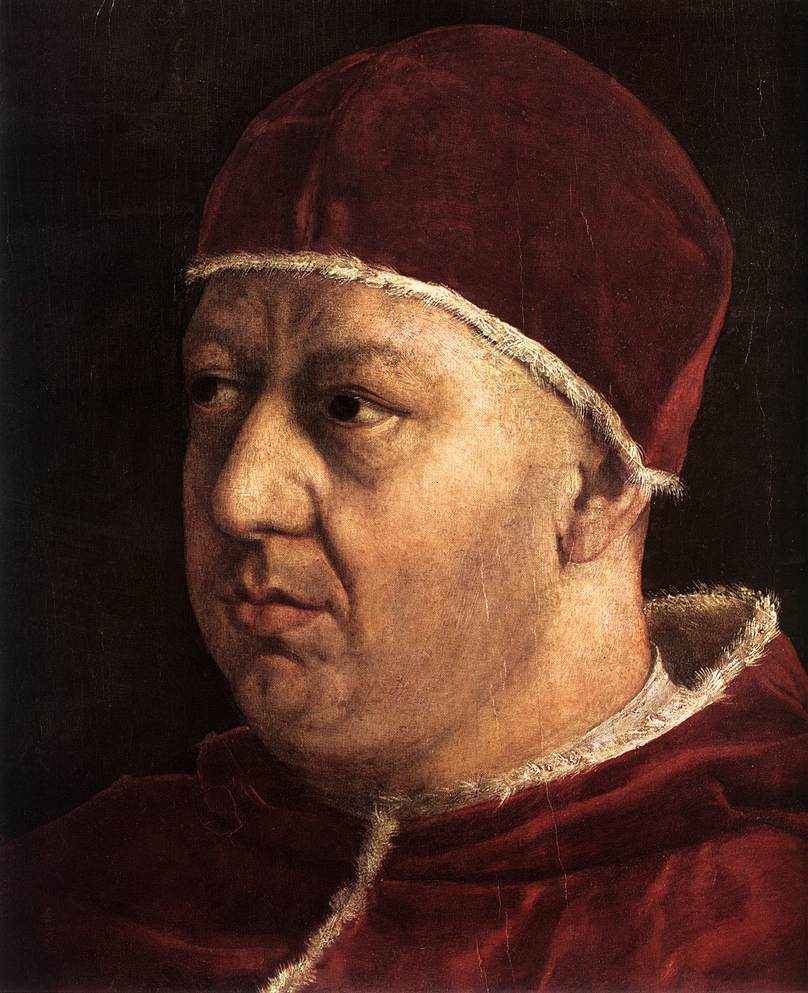 year-old Giovanni dé Medici went from being merely the second son of the tyrant ruler of Florence, to being a Cardinal in the Catholic Church. After these things took place, a good deal of money then passed from Lorenzo dé Medici’s bank to the Papacy.
The thirteen year old Cardinal Giovanni dé Medici would eventually become Pope Leo X. It was Leo X who was Pope when Martin Luther nailed his 95 Theses to the castle church door at Wittenberg, Germany which ignited the Protestant Reformation.
The High Renaissance was a time of great papal and church corruption. A glimpse of that corruption can be seen in this thumbnail sketch. Things were, at a number of points, much worse than what is seen here.
There was bound to be a reaction to the theological and political corruption that then existed at the center of the Western Church.
Coram Deo,
Kenith


