Thursday, June 08, 2006

Email Theology?
I get lots of “religious” emails from well meaning friends and co-workers, and once in a while they are pretty good, but most of them are sappy, guilt manipulating, and some are downright heretical.

Here is an example from an email that I received this evening, "And you shall surely achieve all your goals this year. For the remaining months of the year, all your agonies will be diverted and victory and prosperity will be incoming in abundance. Today God has confirmed the end of your sufferings sorrows and pains because HE that sits on the throne has remembered you. He has taken away the hardships and given you JOY"

Now unless the person who sent this is a prophet (and they are not), than there is no way they can honestly say anything like that to a fellow Christian. The statement is VERY un-Scriptural. The Scriptures tell us that if we are the children of God, than one thing that we can count on in this life is suffering. But the good thing is the Holy Spirit is with us and by the Spirit we can (and will) overcome trials, temptations and sufferings.

And in nothing terrified by your adversaries: which is to them an evident token of perdition, but to you of salvation, and that of God. For unto you it is given in the behalf of Christ, not only to believe on him, but also to suffer for his sake… (Phil. 1:28-29)

And sent Timotheus, our brother, and minister of God, and our fellow labourer in the gospel of Christ, to establish you, and to comfort you concerning your faith: That no man should be moved by these afflictions: for yourselves know that we are appointed thereunto. For verily, when we were with you, we told you before that we should suffer tribulation; even as it came to pass, and ye know. (1 Thess. 3:2-4)

So that we ourselves glory in you in the churches of God for your patience and faith in all your persecutions and tribulations that ye endure: Which is a manifest token of the righteous judgment of God, that ye may be counted worthy of the kingdom of God, for which ye also suffer… (2 Thess. 1:4-5)

For therefore we both labour and suffer reproach, because we trust in the living God, who is the Saviour of all men, specially of those that believe. (1 Tim 4:10)

It is a faithful saying: For if we be dead with him, we shall also live with him: If we suffer, we shall also reign with him: if we deny him, he also will deny us… (2 Tim 2:11-12)

There are many more verses that could be added to the list above.
I hate to throw cold water on the things in that email, but many of these "religious” emails (like the one quoted above) that get passed around on the internet are not biblical and some of them are out and out heretical. The statement above is a good example of a very unbiblical email that is getting passed around. While it may give us warm fuzzes inside when we read it, it is something that we can not say to someone unless we are a prophet from God. And not just that, it directly contradicts much of what we read in the Scriptures about the suffering and persecution that those who follow Christ will have to endure in this life.

Coram Deo,
Kenith

Wednesday, May 31, 2006

Christians and Alcoholic Beverages


I hope you will take a few minutes to read the letter below. It was written by Rev. Bill Smith, then pastor of Fellowship Baptist Church in Sulphur, La. Bill wrote the letter to his good friend and fellow Baptist minister, who was also his former roommate at Mid-America Baptist Theological Seminary in Memphis.

Bill wrote the letter because his friend called Bill very concerned because he found out that Bill’s understanding about Christians and the consumption of alcoholic beverages had changed (Bill no longer believed it was a sin to drink a beer or glass of wine). The conversation did not go well, and Bill sat down, after they hung up, to explain from Scripture why his position had changed from a belief in total abstinence to one of moderation. I hope you find this interesting.

In Christ,
Kenith
+++++++++++++++++++++++++++
Dear R---,

I haven't heard from you since that last e-mail, and I didn't know if it was just because you were busy or because I am anathema now because of my position on alcohol and tobacco. One of the reasons I am writing this e-mail is because I talked with J.'s uncle Al last night. He called me asking me about this. We had an interesting discussion.

I guess a lot of water has passed under the bridge since we have discussed anything, and I did kind of shock everyone. I probably shouldn't have said anything, but it is nothing about which I am ashamed. This e-mail will provide some explanation as to why I came to this position. I hope that this will be passed along to J. and ultimately Al also. Al and I are supposed to talk again sometime.

I have learned that, in fact, it was the Unitarians who actually began the temperance movement in the 1800's. The "conservative Christians" fell in with them because of their distorted view of God's creation, holding an ancient gnostic dualistic view of physical and spiritual; i.e., matter is inherently evil and the spiritual is good. This poses all sorts of problems with biblical Christianity (of which I am a strong adherent).

This brings me to the biblical argument which changed my thinking. Remember, the Bible, God's inerrant revelation of Himself to us, is our only rule of faith and practice. Emotional arguments, arguments from personal experience and cultural practice cannot dictate what we believe and do. Only God's Word should govern our thinking.

The first area with which I would like to deal is our common ground. The Bible is very clear about drunkenness. Drunkenness is a sin which is deplorable in the sight of God. From the Old Testament through the New Testament God has made this very clear.

Prov. 23:21 For the drunkard and the glutton shall come to poverty: and drowsiness shall clothe a man with rags.

Is. 28:1 Woe to the crown of pride, to the drunkards of Ephraim, whose glorious beauty is a fading flower, which are on the head of the fat valleys of them that are overcome with wine!

Luke 21:34 And take heed to yourselves, lest at any time your hearts be overcharged with surfeiting, and drunkenness, and cares of this life, and so that day come upon you unawares.

Rom. 13:13 Let us walk honestly, as in the day; not in rioting and drunkenness, not in chambering and wantonness, not in strife and envying.

Eph. 5:18 And be not drunk with wine, wherein is excess; but be filled with the Spirit.

In fact, drunkenness is a picture and a sign of God's judgment:

Is. 19:14 The LORD hath mingled a perverse spirit in the midst thereof: and they have caused Egypt to err in every work thereof, as a drunken man staggereth in his vomit.

Is. 24:20 The earth shall reel to and fro like a drunkard, and shall be removed like a cottage; and the transgression thereof shall be heavy upon it; and it shall fall, and not rise again.

Is. 29:9 Stay yourselves, and wonder; cry ye out, and cry: they are drunken, but not with wine; they stagger, but not with strong drink. Et. al.

The Bible clearly states that the drunkard (i.e., those whose lifestyle is characterized by drunkenness) will not inherit the kingdom of God (1Cor 6:9-10) because this is a work of the flesh (Gal 5:19-21). I detest drunkenness, and, in fact, have begun church discipline (that might be a new one for you too) on people who have been publicly drunk. Many people do not see how this position is consistent with what I am about to say, but the Bible is perfectly consistent about the issue. The Bible's teaching on alcohol as a beverage is quite clear.

The first word in the Old Testament that is translated wine is the Hebrew word yayin. Some have tried to argue that this word as well as others does not refer to a drink that has the ability to intoxicate in order to maintain the position that abstinence is the only way to think about alcohol, but their arguments are in vain according to the use of the word in the OT. The word is used 141 times in the OT.

This is the fruit of the vine by which Noah became drunk (Gen 9:21, 24), Lot's daughters led their father to drunkenness by yayin (Gen 19:32-35), Eli thought Hannah was drunk with yayin (1Sam 1:14-15), and Nabal was also drunk with yayin (1Sam. 25:37). Many more examples could be cited, but I think this is sufficient.

The interesting thing about yayin, wine, is that it is also seen as a blessing from God (Gen. 49:12 "His eyes shall be red with wine, and his teeth white with milk;" this is in the pronouncement of blessing from God on the tribe of Judah from which our Lord would descend).

In fact, God required yayin to be a part of offerings offered to Him in the OT ceremonies (Ex. 29:40 And with the one lamb a tenth deal of flour mingled with the fourth part of an hin of beaten oil; and the fourth part of an hin of wine [yayin] for a drink offering; cf also Lev. 23:13; Num. 6:20; Num. 15:5, 7, 10; Num. 28:14).

One of the tithes required by the Lord involved the people tithing of all of their produce each year. They were to take this tithe to the tabernacle. But if the stuff they were to take would spoil on the journey, this was God's command:

Deut. 14:26 "And thou shalt bestow that money for whatsoever thy soul lusteth after, for oxen, or for sheep, or for wine [yayin], or for strong drink [shachar], or for whatsoever thy soul desireth: and thou shalt eat there before the LORD thy God, and thou shalt rejoice, thou, and thine household."

God is commanding them to go out and buy these potentially intoxicating beverages so that they and their households may partake and rejoice before the Lord for His goodness! Now, is God promoting sin? Does not God know that this stuff is potentially intoxicating? Is God the author of sin? God forbid!!! The fact is alcohol is seen as a good gift from God to be enjoyed in His presence and for His glory. He is strictly against the abuse of this good gift and all of His other good gifts. But He is NOT against the proper use of His good gifts.

A sign of God's cursing upon His people would be that they would have vineyards but would not be able to drink the yayin from them

(Deut. 28:39 Thou shalt plant vineyards, and dress them, but shalt neither drink of the wine, nor gather the grapes; for the worms shall eat them. Cf also Is. 16:10.)

But the blessing of the Lord would be just the opposite:

Amos 9:14 "And I will bring again the captivity of my people of Israel, and they shall build the waste cities, and inhabit them; and they shall plant vineyards, and drink the wine thereof; they shall also make gardens, and eat the fruit of them."

God says, in His Word,

Psa. 104:15 "And wine that maketh glad the heart of man, and oil to make his face to shine, and bread which strengtheneth man's heart."

The facts are that God prohibits drunkenness, but He encourages the proper view and use of His good gift of alcohol. There is much more that could be said from the OT, but I will move on to the NT for the sake of boring you with all the facts.

The NT is also replete with examples about the use of wine. The Greek word is oinos. Another phrase that is used is tou genematos tes ampelou, the fruit of the vine. The cup Jesus used in the Last Supper was a common term used for the cup of blessing which was understood to be wine. But let's deal with the biblical uses of oinos and oinos neos (new wine).

Jesus compares the kingdom of God as revealed in Himself as new wine (oinos neos). He says that you don't put new wine in old wineskins because the fermentation would burst the already stretched out wineskins. If this stuff were so deplorable, why would our Lord use it for an example of the kingdom of God? Wasn't He as smart as our culture today?

Real liberal theologians say that Christ just kind of mixed in with the times, controlled by the prevailing culture of the day. As a conservative Bible student, I can't hold to this view. Christ was controlled only by the law of God which He came to fulfill. Christ even goes so far as to say that aged wine is much better than new wine (Luke 5:37-39)! And then there is that incident where Christ actually turned water to wine in John 2, His first miracle. Some have tried to say that this word here means "grape juice," but they cannot prove that from the prevailing use of the word oinos. The same word is used throughout this passage to speak about wine.

This wine was potentially intoxicating. Didn't Christ know that there were potential alcoholics there? Did He not know that wine was used in pagan temples? Did He not know that there were problems with drunkenness in His culture (for there was)? Yet He made six waterpots of approximately 40 gallons each of good wine. Gee, that is about 240 gallons of wine! The arguments simply do not stand up to the Word of God.

God does not promote abstinence. He promotes the proper use of His good gifts. In order to say otherwise one would have to deny the example of our Lord, who knowing that people would be following His example in keeping God's law, would have abstained completely if that had been the law of God for us to follow. The people that Jesus really perturbed during His day were the Pharisees. You see, the Pharisees added all of these laws and traditions to the law of God, making void the commandments of God by their man made commandments (Matt 15).

The Pharisees, like the many Christians today, believed that external things such as not washing hands ritualistically before eating defiled a person. Jesus response to the Pharisees was:

Matt. 15:11 "Not that which goeth into the mouth defileth a man; but that which cometh out of the mouth, this defileth a man."

The principle here is that external things of God's creation are not in and of themselves evil. Evil is within the heart of man, not in the things which he puts in his mouth (which would include alcohol!). But just like the Pharisees of Jesus' day, many professing believers want to judge their spirituality by external things; e.g., "I don't do this," "I go to church," "I don't drink alcohol," "I don't use tobacco," "I don't dance," etc. These are all things that make us feel spiritual, but they are not God's standards of spirituality. God's standard of spirituality goes to the heart; i.e., that which comes out of man. Because while one may have "external" righteousness and look real "spiritual" before the world, his heart is corrupt. Paul warns us that spirituality would be judged by these things, and he warns believers against this heresy.

Col. 2:16-17, 20-23 "Let no man therefore judge you in meat, or in drink, or in respect of an holyday, or of the new moon, or of the sabbath days: Which are a shadow of things to come; but the body is of Christ . . . Wherefore if ye be dead with Christ from the rudiments of the world, why, as though living in the world, are ye subject to ordinances, (Touch not; taste not; handle not; Which all are to perish with the using;) after the commandments and doctrines of men? Which things have indeed a shew of wisdom in will worship, and humility, and neglecting of the body; not in any honour to the satisfying of the flesh."

He also says in another place:

1Tim. 4:1-5 "Now the Spirit speaketh expressly, that in the latter times some shall depart from the faith, giving heed to seducing spirits, and doctrines of devils; Speaking lies in hypocrisy; having their conscience seared with a hot iron; Forbidding to marry, and commanding to abstain from meats, which God hath created to be received with thanksgiving of them which believe and know the truth. For every creature of God is good, and nothing to be refused, if it be received with thanksgiving: For it is sanctified by the word of God and prayer."

Though wine is not specifically mentioned, the principle is there. All of God's creation is good and can be used for good and enjoyment when left in its proper context. Those who say otherwise are, according to Paul, promoting "doctrines of demons." One thing that I hope you can see is that my position is clearly the biblical position on the matter.

I have not appealed to you on some emotional or some experiential argument. Some will say that nothing good comes from the use of alcohol (or tobacco, etc; insert your favorite external sin). "My father was a drunkard, and I hate the stuff." These people believe that all of those who promote the use of alcohol in moderation have never had bad experiences in their lives with it. Not true !

My biological father was a drunkard. I have seen the devastating effects of the abuse of alcohol. But my thinking is held captive by the Word of God and not my experience. God's Word dictates what I believe and do, not emotions or experience. My opinions and personal scruples are not the dictates of God. I cannot judge someone liberal or conservative based upon my personal opinions.

There are some objections that have been raise with which I had to deal and have dealt with Scripturally. First, there is the issue of the potential alcoholic (or tobacco abuser; again, insert your favorite external standard of righteousness). The first thing to say about being a drunkard is that this is not a disease, as if it could be cured medically. Drunkenness is a moral problem ground in a lack of self-control. For the Christian, the Spirit supplies this needed attribute to our lives (cf. Gal 5:22-23). Addictions are modern euphemisms for a lack of self control so people can blame their evil on something that "they cannot help." This is simply not true.

Those who are in the Spirit do not fulfill the lusts of the flesh (Gal 5). You know, people focus in on this alcohol issue as the big abuse. But God condemns abuse of food, sex, etc. Every time I take food to my mouth I am a potential glutton. Every time I have sexual relations with my wife I am a potential adulterer (another thing my biological father was). The logic is absurd when taken to its conclusion. Just as with sex and food, left in proper context, the use (not abuse) of all of God's gifts is good and enjoyable. Taken out of proper use and context they are deplorable and immoral.

The second objection is that the Nazarites vow included the abstinence from alcohol. Actually, though, their abstinence was much more inclusive. It involved abstinence from ALL fruits of the vine including grapes, raisins and the skin of grapes (cf. Numbers 6). After the time of his vow was complete and he went through the proper ceremonies, the Nazarite was free from his vow, and God specifically says "He may drink wine" (Numbers 6:20). If God thought it was the best thing for people to do, why didn't He require this of all people? Why didn't He, at least, keep the Nazarites from drinking wine for the rest of their lives?

Let me say at this point, those who wish to abstain from alcohol are welcomed to do so. BUT they are to realize that its not because God commanded them to do so, only by personal conviction (which is a sign of a weak believer). Paul deals extensively with these issues in 1Cor 8--10 and Rom 14. In Romans 14 Paul deals specifically with the eating of meat and drinking of wine. He categorize those who can do these things as "strong" and those who cannot as "weak." This deals with a trained or untrained conscience on these matters.

The point I want to make here is that neither the strong nor the weak can judge the other based upon his own personal convictions that do not deal specifically with God's Word. We do judge things such as immorality (which takes on many forms, 1Cor 5), but on these issues one brother does not have the right to judge another brother. That would include categorizing another as "liberal" or "conservative" based on these non-essential issues!

This brings me to the objection of the use of alcohol being a bad witness. The appeal might again be made to Romans 14 where someone would say, "You are to act in love and not put a stumbling block before your brothers." This is absolutely true. But you must understand what a stumbling block is. This is not merely perturbing another believer. This is a serious offense. This is aiding--or even causing--a brother to sin against his conscience. It would be like inviting you to a party not telling you that there was alcohol in the punch and then telling you after you drank it. You would have sinned against your conscience. That would be wrong. But you feeling uncomfortable around me because I do it, is not included here.

As I said earlier, the Pharisees were constantly perturbed with Jesus because He did things as a "Rabbi" with which they did not agree. This did not stop him from doing these things. He was about the business of correcting their thinking, and bringing every thought captive to the law of God.

To say that it is a bad witness before the world is also erroneous. We have led this world to believe through unbiblical views on alcohol that Christianity is a "touch not, taste not" religion based on external morality. The truth of the matter is that it is a sin to preach or teach anything to be a sin that God does not declare to be a sin. That is adding to the Word of God. This is precisely what the lost Pharisees did, and Jesus condemned them for it.

A good witness would be to help people understand that all of God's creation is good and can only be enjoyed if used within proper context and for His glory. I could keep going on about this, but I hope you can see that I have done my homework. My views come straight from the Bible. Now, if anyone is like I used to be-- "I don't care what the Bible actually says, I know what I believe in my heart"--that person will not be convinced of anything. As long as people let emotions, experience, culture, man-made commandments and external righteousness govern their thinking, they will never be transformed by the renewing of their minds.

Quite frankly I am sick and tired of people trying to impose upon God something that He has not said. Our job is to preach, teach, learn and submit to the Word of God for what it says NOT what we want it to say or think it ought to say. We are not wiser than God on these issues. We are not more righteous than God.

My prayer is (if you have made it all the way through this) that you will not simply pass this off in an unthinking manner. Deal with it. Take an honest look at the Word of God as I had to do and continue to do. I am not the same person I used to be because I am constantly being transformed by the renewing of my mind which comes by the Word of God. I am being sanctified by truth. God's Word is truth (John 17:17).

I refuse to be controlled by man's commandments and traditions. When all is said and done, I am not the one who could be classified as a liberal here. It is my understanding that conservatives believe the Bible, liberals do not. I believe what I have shown you is that I do believe and practice the Bible. I welcome any comments, criticisms or admonitions, but I only take them from God's Word. If I can be proven by sound reason and the Word of God to be wrong, I will change. But if sound reason and God's Word cannot be used to change my thinking, I can do no other. My conscience is bound by the Word of God.

Here I stand!

Passionate for God's truth,

Bill

P.S. If you have any questions about what I believe, please call me. I have been misunderstood and misinterpreted enough. I am not a beast who will attack. I will gladly talk in a congenial way.

*****************


If you would like to know more on this subject I can highly recommend God Gave Wine: What the Bible Says About Alcohol by Rev. Kenneth Gentry. It might interest you to know that Dr. Gentry is a teetotaller and doesn’t drink Alcohol himself.

Sunday, May 28, 2006

Who are the True Martyrs?
In the last several years, Muslim extremists have tried very hard to hijack the Christian title of “martyr.” The modern Muslim “martyr” is not a true martyr, but is someone who is murdering as many innocent people as he can, while killing himself in the process.

The modern Muslim “martyr” is a cold-blooded killer who thinks nothing of slaughtering innocent women and children in his attack. His actions are designed to generate terror in the civilian population. The act of Murder/suicide is not martyrdom.

The Greek word “marturia” from which we get the English word martyr,is found 37 times in the New Testament. It is most often translated as “witness” or “testimony.” And in the traditions of the Christian faith, a martyr is one who is put to death for his witness or testimony to the Gospel of Jesus Christ.

The Christian martyr is one who did not attack his enemies, but instead he loved them enough to go to them and tell them about Christ, even when he knew that his witness may (and often did) lead to his own death, at the hands of those he brought the Gospel to.

In the book of Acts we learn of the martyrdom of St. Steven. Steven, the first Christian martyr, was disputing with men who denied Christ and those opposed to the faith were loosing the debate. These men became angry because of what they heard and since they could not defeat Steven’s arguments they killed him instead.

Steven did nothing more than disagree with those who killed him and told them why he disagreed. The early church was outlawed, because the Church declared that Jesus Christ was Lord instead of Caesar. The Christians did not take up arms and attack those who persecuted them. Instead they prayed for those who wronged them, and brought the Gospel to them, even when the price of “witnessing” or giving “testimony” of Christ’s Gospel might mean that they would be arrested, tortured and thrown to wild beasts (in the arena), and/or put to death.

A true martyr is a witness to the Gospel of Christ, who gives his/her greatest witness to the truth of that Gospel, in his/her willingness to be killed by those who hate the Christ and His Gospel.

It is a horrible misuse and distortion of the noble Christian title of “Martyr” to apply the term to someone who willingly murders innocent people because they think differently than he does. Muslim radicals who willingly, and enthusiastically, murder innocent men, women and children, at the same time they blow themselves to bits, are NOT martyrs. These men are bloodthirsty killers, who send themselves to hell by their murder/suicides.

Coram Deo,
Kenith

Saturday, May 27, 2006

The Kingdom of God: When is it?
Below is a little piece I wrote about eschatology (end times) some years back. I disagree with the current popular understanding dispensational premillennialism, which did not exist before the 1820’s. I believe that view of end times is in error. There are three other views of end times that, unlike dispensationalism, have ancient origins and defenders in the church. I hold to a postmillennial/optimistic amillennial perspective.

I don't defend that position so much in this letter. I do try to show that the kingdom as it is taught in Scripture doesn't fit into a premillennial mode.

I am, as always, interested in your thoughts on this matter.

Soli Deo Gloria,
Kenith

+++++++++++++++++++++
I believe it can be shown that the "kingdom" began at the first advent of Jesus Christ. When Jesus came He ushered in the Kingdom then. Here are only some examples.

In those days John the Baptist came preaching in the wilderness of Judea, and saying, "Repent, for the kingdom of heaven is at hand!" (Matt.3:1, 2)

From that time Jesus began to preach, and to say, Repent: for the kingdom of heaven is at hand. (Matt 4:17)

And Jesus went about all Galilee, teaching in their synagogues, and preaching the gospel of the kingdom, and healing all manner of sickness and all manner of disease among the people
. (Matt. 4:23)

Thy kingdom come. Thy will be done in earth, as it is in heaven. (Matt. 6:10) (Note: This is from the Lord’s prayer. Jesus shows that we are to pray for the Kingdom)

And Jesus went about all the cities and villages, teaching in their synagogues, and preaching the gospel of the kingdom, and healing every sickness and every disease among the people. (Matt. 9:35)

But if I cast out devils by the Spirit of God, then the kingdom of God is come unto you. (Matt. 12:28) (Note: The Kingdom has come. It is here now, if this is so, then the Kingdom it is not what our dispensational brethren think it is.)

Another parable put he forth unto them, saying, The kingdom of heaven is like to a grain of mustard seed, which a man took, and sowed in his field: (Matt. 13:31) (Note: A mustered seed is very small, but over time it grows and becomes a great bush. )

Another parable spake he unto them; The kingdom of heaven is like unto leaven, which a woman took, and hid in three measures of meal, till the whole was leavened. (Matt. 13:33) (Note: The same is true a little leaven in a loaf. It will, over time, expand and fill the whole loaf (again the kingdom starts small) and becomes great.

And I will give unto thee the keys of the kingdom of heaven: and whatsoever thou shalt bind on earth shall be bound in heaven: and whatsoever thou shalt loose on earth shall be loosed in heaven. (Matt. 16:19) (Note: The Church has the keys of the Kingdom now.

Verily I say unto you, There be some standing here, which shall not taste of death, till they see the Son of man coming in his kingdom. (Matt. 16:28) (Note: All those folks that Jesus was speaking to are long since dead. Was Jesus wrong, are did they see him come into His kingdom? I think the He came into His kingdom way back then.)

To whom also he shewed himself alive after his passion by many infallible proofs, being seen of them forty days, and speaking of the things pertaining to the kingdom of God: (Acts 1:3) (Note: After the resurrection Jesus is still teaching His disciples about the kingdom.)

And now, behold, I know that ye all, among whom I have gone preaching the kingdom of God, shall see my face no more. (Acts 20:25) (Note: This verse comes from period that takes place well into the New Testament era, and still the emphasis is on the Kingdom. In the quote above, Paul is speaking to the elders from the church at Ephesus. He is on his way to Jerusalem and may never see these men again. He stresses that he, Paul, preached the Kingdom.

And when they had appointed him a day, there came many to him into his lodging; to whom he expounded and testified the kingdom of God, persuading them concerning Jesus, both out of the law of Moses, and out of the prophets, from morning till evening. (Acts 28:23)
.
Then Paul dwelt two whole years in his own rented house, and received all who came to him, preaching the kingdom of God and teaching the things which concern the Lord Jesus Christ with all confidence, no one forbidding him. (Acts 28:30-31) (Note: Here we see that in the very last verse in the book of Acts Paul is still preaching the Kingdom.)

That ye would walk worthy of God, who hath called you unto his kingdom and glory. (1 Thes. 2:12) (Note: Christians are now called to be in his kingdom.)

I John, who also am your brother, and companion in tribulation, and in the kingdom and patience of Jesus Christ, was in the isle that is called Patmos, for the word of God, and for the testimony of Jesus Christ. (Rev. 1:9) (Note: Notice, in the very first chapter of Revelation John, like those to whom he is writing, is already entered both the tribulation period and the kingdom.)

I quote all of the above (and this is only a fraction of what is written on the Kingdom in the New Covenant) to show that John the Baptist and Jesus both came preaching the nearness of the Kingdom. Some Christians today say that the Church Age is a parentheses and the Kingdom age has been pushed back, because Israel rejected her King. But there is a problem with this because the Kingdom is stressed throughout the New Covenant writings, and we are specifically told that we Christians are in the Kingdom even now, and the Church has in its possession the very keys of the Kingdom (those keys are the Gospel).

The kingdom is not future it is now. It started like a mustered seed, very small indeed, but is growing and will be great.

One more matter. When is the Judgement? It is on the last day, the end of history. Look at what Paul says to Timothy "I charge thee therefore before God, and the Lord Jesus Christ, who shall judge the quick and the dead at his appearing and his kingdom;" (2 Tim. 4:1) Christ will judge the living and the dead at His coming and not 1,000 years after he has come. His coming is the end of history and the consummation of His Kingdom.
.
With this said we have barely scratched the surface of this topic. I believe these things all point away from the premillennial position, but there are much more important items that come into play that we have yet to touch on. One of the most important has to do with how we are to understand the relationship of the church and Israel, but I have said enough for now.

Soli Deo Gloria,
Kenith

Thursday, May 11, 2006

Grace, Works or What?
Over the last few decades there has been a debate about whether or not you could have Jesus as Saviour and reject Him as Lord. This has been a debate among dispensationalists for the most part.

The short answer to this question is a simple -- No. Christ is both Saviour and means that he is also Lord. Here is just a little bit of the biblical reason why

If ye love me, keep my commandments. (John 14:15)

He that hath my commandments, and keepeth them, he it is that loveth me and he that loveth me shall be loved of my Father, and I will love him, and will manifest myself to him (John 14:21)

Jesus answered and said unto him, If a man love me, he will keep my words and my Father will love him, and we will come unto him, and make our abode with him. (John 14:23)

He that loveth me not keepeth not my sayings and the word which ye hear is not mine, but the Father's which sent me. (John 14:24)

Every branch in me that beareth not fruit he taketh away: and every branch that beareth fruit, he purgeth it, that it may bring forth more fruit. (John 15:1)

I am the vine, ye are the branches: He that abideth in me, and I in him, the same bringeth forth much fruit for without me ye can do nothing. If a man abide not in me, he is cast forth as a branch, and is withered; and men gather them, and cast them into the fire, and they are burned. (John 15:5)

If ye keep my commandments, ye shall abide in my love; even as I have kept my Father's commandments, and abide in his love. (John 15:10)

Ye have not chosen me, but I have chosen you, and ordained you, that ye should go and bring forth fruit, and that your fruit should remain: that whatsoever ye shall ask of the Father in my name, he may give it you. (John 15:16)

There is much more that could be added, but I think that is pretty clear. We are saved by grace and it is the Lord working in us both to will and to do His good pleasure. If we do not "will" to do His good pleasure, and if we do not produce good work by His working in us, then we are not saved.

There is no works salvation, but there is also no salvation that is not accompanied by good works and good fruit.

Remember what John wrote in his epistle, And hereby we do know that we know him, if we keep his commandments and He that saith, I know him, and keepeth not his commandments, is a liar, and the truth is not in him.But whoso keepeth his word, in him verily is the love of God perfected: hereby know we that we are in him (1 John 2:3-5)

Remember the fifth point of the Five Points of Calvinism is NOT "Once Saved Always Saved." The 5th point of the Five Points of Calvinism is PERSEVERENCE of the Saints. We are to persevere in the Faith, and that faith, which is all of grace, WILL produce good fruit and good works, and all these are by grace of the Spirit working in us.

Coram Deo,
Kenith

Wednesday, May 10, 2006

Note: I've decided that three blogs are too many for me. So I've decided to combine my History Thoughts and As I see It. So I will be transferring all my History posts over to here. Below is the first transfer
*******************
Christianity, Slavery and the Antebellum South
Slavery is an ancient institution and for millennia it’s moral, political and cultural legitimacy was unquestioned. This was the case when a Dutch ship brought the first African slaves to the English colony of Virginia in 1619. However most slaves in the British American colonies during the first half of the 17th century were of European and not African ancestry. We know these slaves as indentured servants.

The British, like all of historic Christians, believed that Christians were as a people heirs of God’s promises that He made to Abraham and were thereby the true Israel of God. As such they looked to the Law’s of the Old Covenant as a basis for many of their own laws. In the Old Covenant an Israelite could not hold a fellow Israelite in permanent slavery, unless the individual voluntarily made himself a slave for life, which included the sign of piercing his ear, this act testified that he was in permanent subjection. In the Old Testament under normal circumstances an Israelite could not be held in bondage for more than six ears. A Hebrew slave of a fellow Israelite was to be released during the Sabbath year.

The English during the colonial era, still viewed Christians and the church covenantally, they therefore applied the same Old Covenant law about slavery to their times. They did not allow for the permanent or generational enslavement of fellow Christians. A Britain or other European, almost all of whom were baptised in infancy, could sell himself into slavery for a period of years, usually four or five, to obtain passage to the New World. Then after the designated period of time he was released from service, because a baptised brother could not be held in continual slavery.

These indentured servants were the majority of slaves in the colonies for most of the 1600’s, In the later half of the 1600’s the number of African slaves began to increase dramatically, and the number of indentured servants fell off just as dramatically. The Africans were pagans and not a baptised Christian people, and so there was no obligation to free from bondage these unbaptised people.

But the Africans brought to the New World soon came into contact with the Gospel and some turned to Christ and were baptised. This brought about a problem. The planter could not keep a baptised European in perpetual slavery, but what about the African who converted to the Christian faith or more importantly still, his or her children who were baptised in infancy?

Some planters were hesitant to allow the Gospel to reach their African slaves, because they believed (rightly) that if they were baptised then they, or certainly their children would have to be freed.

The Virginia House of Burgesses addressed this concern in 1667. Act III of that year was titled “An act declaring that baptisme of slaves doth not exempt them from bondage” and reads thus:
Whereas some doubts have risen whether children that are slaves by birth, and by the charity and piety of their owners made pertakers of the blessed sacrament of baptisme, should by vertue of their baptisme be made ffree; It is enacted and declared by this grand assembly, and the authority thereof, that the conferring of baptisme doth not alter the condition of the person as to his bondage or ffreedome; that diverse masters, ffreed from this doubt, may more carefully endeavor the propagation of christianity by permitting children, though slaves, or those of greater growth if capable to be admitted to that sacrament. (Original spelling)

Maryland shortly after followed Virginia’s example. This was a major change in the thinking and law of the English. They had understood that baptised peoples could not be held in perpetual and generational slavery. Now for pragmatic reasons, and to make certain that African slaves were not prevented from hearing the Gospel, they made a dramatic and important change in the Law. They mad an exception for the baptised Africans, these people because of this law could be kept in a permanent and generational state of enslavement.

In America it now became the case that Christians could keep fellow Christians in perpetual slavery so long as the fellow Christians were of Black African descent. With the passing of this fatal law slavery in British North America became race-based slavery. Even the pagan American Indian could not be held in perpetual, much less generational, slavery. We see this in a 1670 Virginia law. Act XII of that year titled “What tyme Indians to serve” says this:
Whereas some dispute have arisen whither Indians taken in warr by any other nation, and by that nation that taketh thern sold to the English, are servants for life or terme of yeares, It is resolved and enacted that all servants not being christians imported into this colony by shipping shalbe slaves for their lives; but what shall come by land shall serve, if boyes or girles, untill thirty yeares of age, if men or women twelve yeares and no longer.

The non-Christian Indian was to be held as a slave only for a given number of years, but the African who arrived “by shipping shalbe slaves for their lives.” So it is clear that his or her perpetual slavery was now based exclusively on race.

Slavery had been seen as a necessary part of life by almost every culture on earth for most of human history. But in the 18th century this began to change. By the time of the American Revolution most of the Founding Fathers, North and South, considered slavery to be an evil. Some saw it as a necessary evil, but an evil all the same. This was true of Washington, Madison, Jefferson etc., all of whom were slaveholders.

Patrick Henry, who was also a slaveholder, likewise saw slavery as an evil. In a letter dated January 18, 1773 he wrote “Every thing we can do is to improve it [Note: it = emancipation] , if it happens in our day, if not, let us transmit to our descendants together with our Slaves, a pity for their unhappy Lot, & an abhorrence for Slavery. If we cannot reduce this wished for Reformation to practice, let us treat the unhappy victims with lenity, it is ye. Furthest advance we can make toward Justice [We owe to the] purity of our Religion to shew that it is at variance with that Law which warrants Slavery.

Henry, like most of the founders, hoped that African slavery could be ended, but at the same time they had doubts that both free Europeans and free Africans could peacefully live together without one group slaughtering the other. Thomas Jefferson expressed this in a famous letter. In regard to slavery in the South he wrote “[A]s it is, we have the wolf by the ears, and we can neither hold him, nor safely let him go. Justice is in one scale, and self-preservation in the other.”

In the early part of the 19th century most abolitionist/emancipation societies were in the South, but they feared that the two races could not both inhabit the same land in a peaceful coexistence . So they sought to transplant the Africans either to Africa, the West or elsewhere in the Americas.

The Southern view changed dramatically in the 1830’s. This was brought about by the rise of radical abolitionists in the North. The new abolitionists movement’s founders came out of the Unitarian and Transcendentalists ranks, and were staunchly anti-Christian. These Abolitionists did not just see slavery as an evil, they declared slavery to be sin and said the slaveholders themselves were evil as well.

The attack from the Unitarian and Transcendentalist abolitionist movement sent the Christians in the South to their Bibles to prove biblically that Slavery was certainly allowed by God and was therefore not necessarily sinful. They pointed out that the Father of the faith Abraham was a slaveholder. Southerners also pointed to the Old Testament and showed where slavery is regulated by God’s law and is by no means condemned.

The Southerners pointed out that Jesus lived in a society where slavery was a normal everyday thing. They correctly argued that Jesus never condemned nor argued against slavery. The Southerners could even point to the New Testament epistle of St. Paul to Philemon. Philemon was a Christian and a slaveholder.

During this period of time the South was becoming a more overtly Christian culture, while in the North Unitarians, Transcendentalists, cultists and revivalists were eroding the Christian foundations of that region. The Abolitionists arguments were mostly humanistic and emotional and it was easy for the Southerners to counter with Scripture. Slavery was clearly allowed and regulated by God in the Bible and it was easy to point that out to Americans North and South.

Before the rise of the more radical abolitionists movements in the North, Southerners had generally considered slavery an evil that they had inherited, but now they defended and also presented it as a positive institution.

Rev. Robert Lewis Dabney, a strong defender of the South and Southern slavery, pointed out this change in attitude in a letter he wrote in 1840. Dabney wrote “Before the abolitionists began to meddle with our affairs, with which they have no business, I remember that it was the common opinion that domestic slavery was at least injudicious…I do believe that if these mad fanatics had let us alone, in twenty years we should have made Virginia a free state. AS it is their unauthorised attempt to strike off the fetters of our slaves have but riveted them on the faster. Does this fact arise from the perversity of our nature? I believe that it does in part. We are less inclined to do that which we know to be our duty because persons, who have no right to interfere, demand it of us.

Southern attitudes changed, as Dabney points out, in reaction to the abolitionist onslaught. At the same time pastors like Dabney and countless others, even while defending slavery against Northern Abolitionists attacks, wrote and preached to their Southern brethren that much of Southern slavery fell far short of the standards set forth in the Bible. The preachers warned that unless they reformed the institutions and brought it in line with the Word of God that God would bring judgement upon them.

Yet they failed to address the grievous error of 1667. They never addressed the fact that they had discarded the covenantal aspects of their theology so as to maintain the Africans in life long and generational slavery. Southern slavery, despite it numerous failings was far more benign than slavery in other parts of the New World. Only five percent of the people taken from Africa ever made it to the United States. The Africans reproduced and thrived in here, while in other parts of the New World the slaves had to be constantly resupplied because of the high mortality and the lack of children.

The South had nearly two hundred years to correct their horrible misjudgement of 1667. The Africans had been, from an early time, presented the Gospel in the America. They had become a baptised Christian people and if biblical law is valid, as they certainly believed, then they were obligated to set these people free.

On a constitutional level the Southerners were correct. The South could secede from the Union, but biblically Southern slavery failed to ever address the great sin of making Christian brethren perpetual slaves based on the colour of their skin. Had Southerners been true to their own doctrinal understanding of the Word of God, then the Africans would have been emancipated long before the War Between the States.

It took a tragic war, in which many Christians on both sides died, to correct the decision of Act III made by the Virginia House of Burgesses in 1667.

Coram Deo,
Kenith

Monday, February 27, 2006

I Shall Loose None and Yet Some Will Be Cut Off

What follows is a slightly edited version of something I posted at Semper Reformanda, as further clarification of the post below this one.
++++++++++++++++

It is clear that in Matthew 7 (which is a Gospel written primarily for the Jews) Christ is talking to God's Covenant people. Covenant people are God's people; these people were the wife of God, Covenantally speaking. These same people could, and many would, be cut off from the covenant people of God for rejecting Jesus Christ (see Rom. 11). Even today the Lord's covenant people (the Church) can be cut off as we see in Romans 11 and many other portions of the New Covenant Scriptures.

All God's covenant people, who are not predestined, before the foundation of the world, to persevere in the faith will hear these terrible words from the mouth of Christ: "I never knew you: depart from me..."

In one since all Covenant people are attached to Christ, this is by circumcision in the Old Covenant and by baptism in the New Covenant. And yet we see these same covenant peoples, in both Old and New Covenants, threatened with being cut off and we see that some are cut off from the People of God.

This is why "All" Israel was not Israel, and also why God's covenant people (branches connected to the vine -John 15:3-8) can be "cut off" and cast into the fire. Some of God's covenant people are wheat, whom God knows salvifically, and some of God's covenant people are tares. In the parable of the wheat and tare, some folks miss the fact that the parable is about the kingdom of heaven. The field is God's kingdom, and it contains both wheat and tares (Matt 13:24). It is to these people, the tares, that Christ will say "I never knew you: depart from me..."

We can be part of the people of God (saints/holy/set apart from the world), be part of the bride of Christ (the church), be in Christ (as branches, connected to a vine or olive branches connected to a tree) and at the same time be tares instead of wheat in the kingdom of God. In both Old and New Covenants we find that the people of GOd are a mixed multitude. All of them bare the outward sign of the covenant, circumcision in the Old and Baptism in the New, but not all of them have circumcised hearts and have made their calling and election sure (II Peter 1:10) by trusting in Christ as Lord and Saviour.

I think the big problem with the debate over whether or not one can loose his/her salvation has to do with the fact that we don't read these things in the biblical context of "Covenant." It is only in light of covenant that we can make perfect sense of the promises that none that the Father gives to Christ will be loss, and at the same time acknowledge the fact that some in Christ can be "cut off."

If we ignore covenant and play proof text table tennis, than we are implicitly saying that the Bible says contradictory things on this issue, and (as we all know) that is not the case.

In Christ,
Kenith

Saturday, February 25, 2006

Can't Stop Discussing Perseverance
I am once again in a discussion of "perseverance" on the Semper Reformanda section of Christian Forums. Earlier I was discussing it with Calvinists who had mixed up the idea of perseverance with "once saved, always saved" (OSAS). Now I'm discussing it with a couple of Roman Catholics (one who is Augustinian) who assume that Reformed perseverance is no more than OSAS.

Here is my latest post:
Ok; so far we have several verses presented that clearly teach that one can not be lost if they are called by the Father. All those who are called in this way are not lost and will not be lost. They will persevere in the faith until the end. Calvin certainly believed this, as did St. Augustine.
WR presented 12 verses that he says contradict the perseverance teaching of Calvinists because, according to WR, “All of them clearly affirm the reality of “apostasy.’”

Here again we find that WR does not understand Reformed thought. Reformed Christians clearly believe in apostasy. The Scriptures themselves give us examples of apostasy, and we find countless about apostasy in both the Old and New Covenants.

What often happens when these verses are set up next to one another is we get into a game of proof text tennis. Each side bounces its verses across the net, but they are often ignored by the other side, and the other side quickly lobs it’s on “proof text back the other way.

We know that both set of texts are true. They are both yea and amen. Throwing them back and forth is useless, and does a disservice to the Word of God, because it seems to imply that one set or the other is false, but this can not be and is not so.

The Scriptures are ALL God’s Word and our theology must be able to make sense of both sets of texts in context. I think the Reformed Faith does this better than anyone else, and it does so by using and teaching the biblical concept of covenant.

Q: Who were the Scriptures written to?
A: The Scriptures were written to God’s Covenant people.

Q: Are all God’s covenant people “His people?”
A: Yes

Q: Are they all saints (set apart-holy)?
A: Yes.

Q: Can a saint apostatise?
A: Yes.

Q: Are all saints elect unto eternal salvation?
A: No.

Q: Are they all wheat?
A: No, many of God’s covenant people are tares and will, on the final day, be judged.

Q: Were those who will be damned ever “in Christ?”
A: Yes, they were grafted into Christ (covenantally) in their baptism. They were part of Christ Church, His bride, which is where there is Salvation, and it is a grave and terrible sin for one who has been baptised and grafted into Christ to not make his election and salvation sure. This is one who proves that he was a tare and not wheat.

Q: Can you and I tell the wheat from the tares?
A: No, but all the wheat will persever as wheat.

Q: What will Christ say, on the last day, to everyone who forsook his/her membership in Christ and His Church, by not making his election and salvation sure?
A: “But He will say, 'I tell you I do not know you, where you are from. Depart from Me, all you workers of iniquity.'”

Either the Bible is contradictory, or these different proof texts (used by both sides) must be understood in light of covenant. In order to teach and understand covenant, we must be willing to think and not insist on a simple either/or situation. There is a bit more nuance involved in the Scriptures than most people and theologies are willing to deal with. Our theology MUST allow us to accept both sets of proof texts as true or we must dump our theology. We have to be able to explain them without contradiction. I believe The Reformed faith does this better than anyone else that I have studied, including some modern "Reformed" statements on the subject that seem to miss some important nuances and defend more of an OSAS position, instead of a covenantal understanding of covenant and perseverance.

The RCC position does deal with some of these things, but those Catholics who do believe in predestination fail (IMHO) to fully address the Scriptures that mention God loosing none who come to Christ and are given him by the Father.

I don't think they can explain the fact that Christ, on the day of judgement, can say to those who fell away “I never knew you; depart from Me, you who practice lawlessness!” They fell away, covenantally, and yet He never knew them, because they never made their calling and election sure. Had they done so they would have persevered. As John says of those who apostatise, “They went out from us, but they were not of us; for if they had been of us, they would have continued with us; but they went out that they might be made manifest, that none of them were of us.

Apostasy is very real ,as is perseverance of the saints. The historic Reformed position, which is Covenantal, takes all Scripture seriously.

Coram Deo,
Kenith

Sunday, February 19, 2006

The Old Covenant and Cajun Cooking
I am so thankful that we are not bound to keep the Old Covenant dietary laws. If we were than we Cajuns would have to give up almost all our favourite foods.

We would no longer be able to eat our sausages, boudin, andouille, taso and (of course) hoghead cheese, all of which contain pork. We would also have to do without most of our sauce piquants, etouffees, and court bouillons, because they contain shrimp, crawfish or catfish all of which are not allowed by the “shadows” which are the Old Covenant dietary laws.

Our gumbos too would suffer. Seafood gumbos would not be possible because they contain shrimp, crabs and lots of times oysters as well. Regular chicken and sausage gumbo would have to be made without the sausage.

Worst of all we would have to give up our crawfish, shrimp and crab boils.

These laws would also do away with many of our favourite American foods as well. No Cheeseburgers (can’t mix dairy and meat) and Pepperoni and other pizzas that contain meat would also have to go.

I am so thankful for the Jerusalem Council in the Book of Acts and James’ decision where we learn that we are no longer to be bound by the shadows of the Old Covenant law.

The staple of the Cajun meal is rice; keep that in mind as you read below. Cajuns take God’s command to Peter seriously “rise, kill and eat.” There is an old Cajun joke about to Cajuns out in the rice field working when they see a Flying saucer land and an alien get out. One Cajun turns to the other
“Wat do you tink dat is?” the other replies as he picks up his shotgun, “ I don’t know. Go cook some rice!”

Coram Deo,
Kenith

Friday, February 17, 2006

St. Augustine: On the Gift of Perseverance

This morning I finished reading St. Augustine’s Treatise on the Gift of Perseverance. What a great read. I love reading the fathers of the Church and Augustine soars above most of them. I wish every Roman Catholic would read this treatise by Augustine. If they did they would see how closely (mirror image) we Calvinists are doctrinally aligned with the great St. Augustine on the subjects of predestination and perseverance.

I highly recommend this work to all my Reformed brethren. It is not that long, and is a gold mind. Augustine deals with so many of the objections to predestination and perseverance that still comes up today. After more than 1,500 years, so many of the objections remain the same.

Read this treatise; you will not regret it.

Coram Deo,
Kenith

Tuesday, January 10, 2006

Medieval Monks and Alter Calls
I was baptised a Roman Catholic and years later, during an invitation, I walked down the aisle of a Southern Baptist Church and prayed the sinners prayer.

God truly saved me at some point in there. I don't know when, but I do know that I wanted to know Jesus Christ as Lord and Saviour. I walked the aisle in that church because I loved Jesus Christ. I loved the Lord, because at some point before my heart had been changed by the Holy Spirit.

There are countless Christians who have affirmed they are saved by walking and aisle and praying a prayer. But doing that saves no one. It is the work of the Holy Spirit.

The walk down the aisle motif of modern evangelical Christianity is based on misguided, revivalist thinking. But many Christians today associate it with salvation. However, the alter call is an invention of 19th century revivalism, that has (IMHO) serious theological problems. Still God has used it despite its theological flaws. Of course such flaws, though used by God, also bring error in thier wake as well.

It is like early Medieval monasticism. Monasticism is not biblical and has some theological problems as well, but God used this flawed system to convert Europe to the Gospel and to preserve the Scriptures for us today. This monasticism did great good, and on the other hand, was the breeding ground for great error.

Remember, even in our errors and sins, God will accomplish His will. We are responsible before Him for our errors, but thankfully He is God and none of our frailties (or sins) can thwart His plan and all of them are used to accomplish all His most Holy Will.

Coram Deo,
Kenith

Sunday, January 08, 2006

John Calvin: Perseverance is not OSAS


I posted these quotes from Calvin's Commentaries here on the blog because of a discussion over the idea of Once Saved Always Saved (OSAS) as against the Reformed teaching of Perseverance of the Saints that I have been engaged in on the Ask a Calvinist section of Christian Forums (CF).

Many in the Reformed Faith today have confused the (non-Calvinist) Baptist view of OSAS with the historic Reformed doctrine of Perseverance of the Saints, that was once taught by all Reformed Churches.

OSAS is NOT the same as Perseverance of the Saints. It is a truncated, misguided, imposter of the true Reformed Doctrine of Perseverance.

Below area some samples of what Calvin says in his commentaries on the subject of Perseverance of the Saints. I can produce more if they are needed.

++++++++
We see too many of this class in our own day, who eagerly embrace the Gospel, and shortly afterwards fall off; for they have not the lively affection that is necessary to give them firmness and perseverance. Let every one then examine himself thoroughly, that the alacrity which gives out a bright flame may not quickly go out, as the saying is, like a fire of tow; for if the word does not fully penetrate the whole heart, and strike its roots deep, faith will want the supply of moisture that is necessary for perseverance. (Commentary Matt. 13:20)

Although, then, the charity of many, overwhelmed by the mass of iniquities, should give way, Christ warns believers that they must surmount this obstacle, lest, overcome by bad examples, they apostatize. And therefore he repeats the statement, that no man can be saved, unless he strive lawfully, so as to persevere to the end. (Commentary Matt. 24:13)

But the general instruction of the parable consists in this, that it is not enough to have been once ready and prepared for the discharge of duty, if we do not persevere to the end. (Commentary Matt. 25:1)

Here Christ warns them, in the first place, that it is not enough for any one to have begun well, if their progress to the end do not correspond to it; and for this reason he exhorts to perseverance in the faith those who have tasted of his doctrine... He distinguishes his followers from hypocrites by this mark, that they who falsely boasted of faith give way as soon as they have entered into the course, or at least in the middle of it; but believers persevere constantly to the end. If, therefore, we wish that Christ should reckon us to be his disciples, we must endeavor to persevere. (Commentary John 8:31)

But as he governs those whom he has elected, all the engines which Satan can employ will not prevent them from persevering to the end with unshaken firmness. And not only does he ascribe to election their perseverance, but likewise the commencement of their piety. (Commentary John 13:18)

He again lays before them the punishment of ingratitude, and, by doing so, excites and urges them to perseverance. It is indeed the gift of God, but the exhortation to fear is not uncalled for, lest our flesh, through too great indulgence, should root us out. (Commentary John 15:6)

In like manner, when Christ exhorts us, in this passage, to perseverance, we must; not rely on our own strength and industry, but we ought to pray to him who commands us, that he would confirm us in his love.
(Commentary John 15:9)

He has laid down the doctrine, and now, with the view of impressing it upon the minds of the Corinthians, he adds an exhortation. He states briefly, that what they had hitherto attained was nothing, unless they steadfastly persevered, inasmuch as it is not enough to have once entered on the Lord’s way, if they do not strive until they reach the goal, agreeably to that declaration of Christ — He that shall endure unto the end, etc. (Commentary 1 Cor 9:24)

Here we have an exhortation to perseverance, by which he admonishes them that all the grace that had been conferred upon them hitherto would be vain, unless they persevered in the purity of the gospel. And thus he intimates, that they are still only making progress, and have not yet reached the goal. (Commentary Col. 1:23)

He commends them for having begun well; but lest, under the pretext of the grace which they had obtained, they should indulge themselves in carnal security, he says that there was need of perseverance; for many having only tasted the Gospel, do not think of any progress as though they had reached the summit. Thus it is that they not only stop in the middle of their race, yea, nigh the starting-posts, but turn another way…But if he is possessed by faith, we must persevere in it, so that he may be our perpetual possession. Christ then has given himself to be enjoyed by us on this condition, that by the same faith by which we have been admitted into a participation of him, we are to preserve so great a blessing even to death. (Commentary Heb. 3:14)

And, indeed, we see that under the Papacy a diabolical opinion prevails, that we ought to doubt our final perseverance, because we are uncertain whether we shall be tomorrow in the same state of grace. But Peter did not thus leave us in suspense; for he testifies that we stand by the power of God, lest any doubt arising from a consciousness of our own infirmity, should disquiet us. (Commentary Pet. 1:5)

He does not speak here of the constancy of men, but of God, whose election must be ratified. He does not then, without reason declare, that where the calling of God is effectual, perseverance would be certain. He, in short, means that they who fall away had never been thoroughly imbued with the knowledge of Christ, but had only a light and a transient taste of it. (Commentary 1 John 2:19)

I hope you have found these examples useful. OSAS is in imposter. I will stick with Calvin and the great Reformed Creeds and Confessions on this issue and not with my (dear) modern, non-Calvinistic, Baptist brethren who teach OSAS instead of perseverance.

In Christ,
Kenith

Ps. I spend most of my time at Cf on the Semper Reformanda forum. Come and join the discussion.

Wednesday, January 04, 2006

Perseverance or Once Saved Always Saved?
I think the only way to rightly understand the 5th point of the Five points of Calvinism is covenantally. If you read a good bit of Calvin you will see that he clearly (rightly) believed in the perseverance of the saints, but at the same time he took the warnings in the New Testament against apostasy fey seriously.

On of the reasons many Calvinist today struggle with the notion of apostasy is many Calvinists confusion the modern Baptist notion of "once saved-always saved" (OSAS) with the true Calvinist position of perseverance. I believe that is because many Calvinists have ceased to understand these things from a Covenantal perspective. We have become individualists (i.e. baptistic) in our thinking and not covenantalists (that is Reformed).

In Calvin's Strasburg Catechism for young Children in the first questions he asks the child these questions:

Teacher: My child, are you a Christian in fact as well as in name?
Child: Yes, my father.
Teacher: How is this known to you?
Child: Because I am baptized in the name of the Father and of the Son and of the Holy Spirit.
-
All who are baptised are in Covenant, and are part of the outward people of God. The Bible is written to these people. Are they all regenerate? No, some may be in the Church (which is the body of Christ) and therefore a branch that is connected to the true vine.

These people are covenantally attached to Christ, but if they do not persevere in faith iv they do not work out their salvation in fear and trembling they will be cut off. It was the same Old Covenant Israel.

The problem with OSAS is that it does not take the many warning of apostasy seriously, but the Calvinistic doctrine of perverance does. Perseverance is biblical OSAS is not.

Don't misunderstand me. All who are elect, before the foundation of the world, will persevere, but the Scriptures of the Old and New Testament are written to God's Covenant people. They are all, at some point, His people though many of them may not know Him in faith and if they do not come to faith and persevere in faith they will be cut off from the covenant, they will be branches broken off of the true vine (which they were attached to covenantally) and cast into the fire.

So much for my two cents on this subject.

Coram Deo,
Kenith

Sunday, January 01, 2006


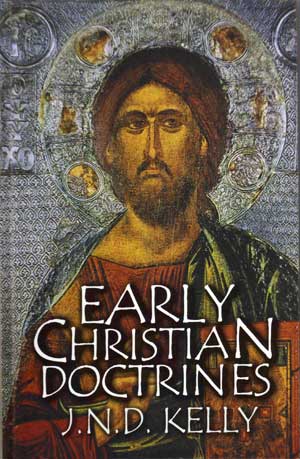
I thoroughly enjoyed reading J.N.D. Kelly’s book Early Christian Doctrine. I found it to be very informative and consider every minute I spent reading, underlining and researching what I read to be time well spent.

This is not an easy book to read and it can be confusing, because the Early Church Fathers arguments/treatises can be confusing as well. I crawled through this book and still I’m not confident that I understand all that Kelly brought up, but I did learn a lot and look forward to reading more of the writings of the Fathers themselves and books on them.

My readings in the Fathers, so far, have shown me that modern Evangelicals need to know something of the Fathers and how they relate to us as our elder brothers in the Lord our God. The Christians Church (past, present, future) is an organic unity. Still, Evangelicals see no need for knowing, nor do they care what the Fathers believed or taught. I believe they are impoverished and ignorant because of this. They also have a grossly truncated understanding of the Church. For most Evangelicals “that old time religion” only goes back a generation or two (if that much). Considering that the New Covenant Church began 2,000 years ago (50 generations) that is pathetic.

Roman Catholics do, far more than Protestants, understand the organic unity of the church. They believe that what the Fathers have to say is important. But my readings of and about the Early Church Fathers have shown me that the Roman Catholic Church claims too much from the Fathers. Roman Catholics understand that the Church is one --past, present and future—but I find that they try to make the Fathers conform to their current teachings, and on many points, certainly not all, they have to distort or exaggerate what was taught or believed by the Fathers to justify some current teachings and practices that I believe to be unbiblical.

Coram Deo,
Kenith

Saturday, December 03, 2005

Dr. Bahnsen science and creation.


In my opinion, one of the most gifted Christian thinkers of the 20th century was Dr. Greg Bahnsen. Bahnsen is probably best known as an “apologist” or defender of the Christian faith. He has debated and crushed a number of prominent academic atheists this includes his legendary debate with Dr. Gordon Stein (Read more here). Greg Bahnsen, was (he passed away in late 1995) a man of great learning and simple faith.

The quote below is from a paper he wrote about biblical revelation and modern science. Bahnsen said "Despite the enthusiasm of modern science in pursuing study and research on the 'origin of life,' it must be recognized that all questions of origins fall outside the realm of empirical science! ... In the matter of origins, where the scientist can neither observe nor experiment, one is left to depend either on guesswork speculation or infallible revelation."

Bahnsen makes a very important point here that is missed by most Christians and non-Christians alike. The study of origins can not, by its very nature, be "science" as it is defined in the modern world. The study of origins is philosophy and theology and can never be truly “empirical” science. When scientists speak of origins in scientific terms they are promoting their philosophy, religion and worldview not empirical facts.

Observation, experimentation and verification are the methods used in empirical science. None of these are possible for the creation, because it is an event that took place before man came on the scene. The evolutionist is an evolutionist by FAITH and not by science. He believes as he does, not because it is proven scientifically, but because he chooses to. It is his leap of faith, and it is a great leap.

For the Christian to bow to modern science and attempt to make the Christian faith fit with the evolutionist faith; is to compromise with a false religion that is always changing. Evolution is atheistic religion and not science.

Soli Deo Gloria,
Kenith

PS. The audio from the Bahnsen/Stein debate are available: Monergism Books, or you can read a transcription here. The audio was online at "The Great Debate: Does God Exist?" but the link is not working tonight.

PPS (This blog is a rerun from 03 March 2004)

Saturday, November 19, 2005

Reformed Theology and Baptismal Regeneration ?


I hate to come in and burst a few of my Reformed brethrens bubbles but (much to the surprise of many Reformed Christians) there is version of baptismal regeneration that is found in some Reformed circles.

Cornelius Burges, one of the more important Westminster Divines, the man who penned the Confession, and who played an important part in the committee that gave us the confession’s section on baptism wrote a (once) famous book on this subject titled Baptismall Regeneration of Elect Infants, Professed by the Church of England, according to the Scriptures, and Primitive Church, the Present Reformed Churches and Many Particular Divines Apart. I know the title is a mouth full. I wish it were on the web, but it is not.

There were other divines at the Westminster Assembly who agreed with Burges on the issue of Baptismal regeneration of "elect" infants. Modern Reformed Christians need to remember that these men were highly respected Reformed pastors and theologians, who played an important part at Westminster. You have often had some Reformed Theologians that have held to a (qualified) understanding of baptismal regeneration.

I happen to have a photo-copied version of Cornelius Burges' book. It is interesting reading and very difficult reading as well. I am not yet sure what I think of it but it is an interesting topic to look at from an older Reformed vantage point.

Dr. Joel Garver has an interesting article on this subject titled Baptismal Regeneration and the Westminster Confession 28.6. Some of you may find it interesting. I did, but I am not sure what I think about this subject. It is not high on my list of topics to tackle.

Dominus vobiscum,
Kenith

Sunday, November 06, 2005

Augustine and Reconciliation

If you look at my profile at Christian Forums you will see that I describe myself as a “Reformed Christian” and that I migrated into “Reformational Christianity” after being born and raised Roman Catholic and then Baptist. I later say that “I consider myself to be a Reformational catholic” (Notice the little “c”).

This morning I was reading Dr. Philip Schaff’s introduction to St Augustine in the Nicene and Post Nicene Fathers (series I vol. I). In speaking of Augustine he says, in the chapter titled The Influence of St. Augustin upon Posterity and his Relation to Catholicism and Protestantism:

Such a personage as Augustin, still holding a mediating place between the two great divisions of Christendom, revered alike by both, and of equal influence with both, is furthermore a welcome pledge of the elevating prospect of a future reconciliation of Catholicism and Protestantism in a high unity, conserving all the truths, losing all the errors, forgiving all the sins, forgetting all the enmities of both. After all, the contradiction between authority and freedom, the objective and the subjective, the churchly and the personal, the organic and the individual, the sacramental and the experimental in religion, is not absolute, but relative and temporary, and arises not so much from the nature of things, as from the deficiencies of man’s knowledge and piety in this world. These elements admit of an ultimate harmony in the perfect state of the church, corresponding to the union of the divine and human natures, which transcends the limits of finite thought and logical comprehension, and is yet completely realized in the person of Christ. They are in fact united in the theological system of St. Paul, who had the highest view of the church, as the mystical “body of Christ,” and “the pillar and ground of the truth,” and who was at the same time the great champion of evangelical freedom, individual responsibility, and personal union of the believer with his Saviour. We believe in and hope for one holy catholic apostolic church, one communion of saints, one flock, one Shepherd. The more the different churches become truly Christian, the nearer they draw to Christ, and the more they labor for His kingdom which rises above them all, the nearer will they come to one another. For Christ is the common head and vital centre of all believers, and the divine harmony of all discordant human sects and creeds. In Christ, says Pascal, one of the greatest and noblest disciples of Augustin, In Christ all contradictions are solved.

Schaff was a great man. He left us some monumental works including:
History of the Christian Church (8 vol.) and in book form here.
Creeds of Christendom (3 vol) and in book form here.
Early Church Fathers (38 Vol.) and in book form here.
Schaff-Herzog Encyclopedia (13 Vol.)

I like Schaff’s optimism about a possible (distant) future reconciliation of the Western Church, after all I am a very optimistic amillennial/postmillennialist. There are things in Augustine that both branches of the Church hold in common and there are sections of Augustine in which Roman Catholics embrace and the Protestants shrink from and vice versa.

Dominus Vobiscum,
Kenith

Sunday, September 11, 2005

John Calvin and the Lord's Supper
Calvin had a high view of the Eucharist/Lord's Supper. I think most Calvinists today would be shocked by Calvin's views in that area. He did disagree with both transubstantiation (Roman Catholic view) and consubstantiation (Luther’s view- Note: I don't think our Lutheran brethren like this term but I don't know another way y put it.) but he was light years away from the views held by modern evangelical Protestants including many Reformed Christians.

Below are a few of Calvin’s many statements on whether we truly partake of Christ in the Supper. What I quote here is only PART of what he says, he does make important qualifications also. This is an interesting Subject that I hope more Reformed Christians will look into. Before I give the quotes let me recommend a book Given for You: Reclaiming Calvin’s Doctrine of the Lord’s Supper by Keith Mathison. (BTW-- R.C. Sproul recommends this book and wrote the preface to it.)

These quotes are taken from another good book that I highly recommend: John Calvin’s Treatises On the Sacraments.
.............
I distinctly affirm that those who receive the promise by faith, become truly partakers of Christ, and are fed by his flesh. Therefore, the eating of Christ is something else than the receiving of the promise, if indeed he admits that the cause differs from its effect.I deny not, indeed, that those who exclude the substance of vivifying flesh and blood from the communion defraud themselves of the use of the Supper. (265)

I am said to defame those who hold that the true flesh of Christ is distributed in the Supper: as if I did not uniformly declare, in distinct terms, that nourishment from the true flesh of Christ is set before us in the Supper. (267-268)

If any sincerely and distinctly teach that the flesh of Christ is set before us to be eaten by us, I, too, am of the number. (268)

But although the true body of Christ is eaten in the Supper, this is no ground for holding, as they do, that spiritual interpretation is excluded. This interpretation would define the mode, and show the two things to be perfectly reconcilable, viz., that the same body which was once offered as a victim is given to us, and yet is not eaten in a carnal manner. Certainly in the age of Augustine and Jerome no man doubted that the body of Christ was one. (439)

John Calvin's reputation is often far from the reality. Many of his followers would be horrified by his views on both baptism and the Eucharist. He did not agree with Rome on these two things, but he is light years removed from the Zwinglian like views of modern Evagelicals (even most Calvinists).

I am reading a lot of Calvin, and I am often surprised by what I find. I thought I would share some of those "found" items here. I hope none reading this will simply dismiss Calvin on these things. I encourage you to read Mathison's book. It was after reading Mathison that I HAD to get Calvin’s Treatises On the Sacraments.

Coram Deo,
Kenith